
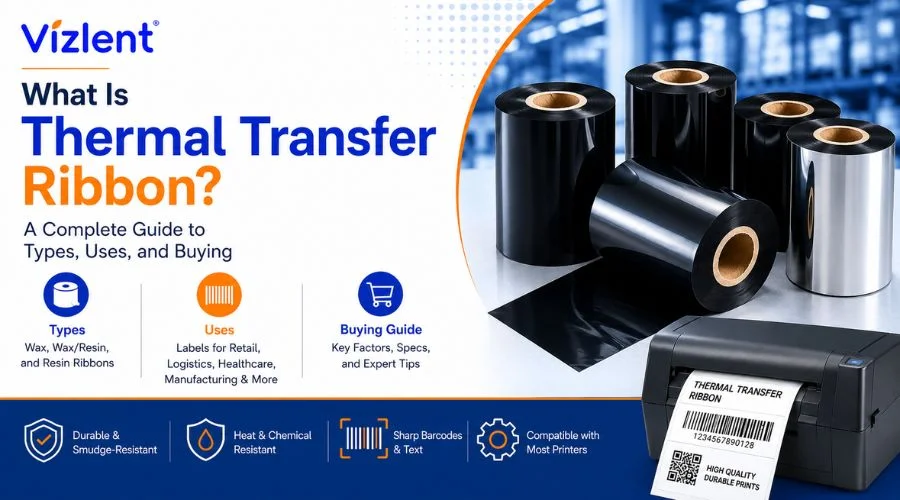
Thermal transfer ribbon is a coated film that carries wax, resin, or wax-resin ink and transfers a permanent image onto a label when heat from a printhead melts that ink onto the surface. This printing method exists because direct thermal printing cannot produce durable, long-term barcodes on most industrial substrates. A printer draws the ribbon and label through together, applies precise heat through hundreds of tiny elements, and leaves ink bonded to the label while the spent ribbon winds onto a take-up spool. Ribbon types, wax versus resin selection, common uses, colors, core specifications, and cost all shape which ribbon a buyer should source with confidence.
How a Thermal Transfer Ribbon Printer Works
A thermal transfer ribbon printer feeds ribbon and label stock together through a thermal printhead, where thousands of individually controlled heating elements melt ink at precise points along the ribbon’s coating. The melted ink transfers onto the label facestock in the exact pattern of the barcode or text, then cools and bonds almost instantly as the label advances past the printhead. This is the direct answer to does thermal transfer use ribbon: yes, it is the defining feature that separates thermal transfer technology from direct thermal printing, which uses no ribbon at all.
Print speed, resolution, and darkness settings on a thermal transfer ribbon printer all interact with the ribbon’s ink formulation, so mismatched settings cause smudging, ghosting, or ribbon snapping. Printer brands including Zebra, Sato, Datamax, and Honeywell use broadly similar printhead technology, which is why most industrial ribbons are engineered for cross-brand compatibility. Getting the printer configuration right on day one prevents the majority of print quality complaints reported by converters and end users.
What Is Thermal Transfer Ribbon Made Of?
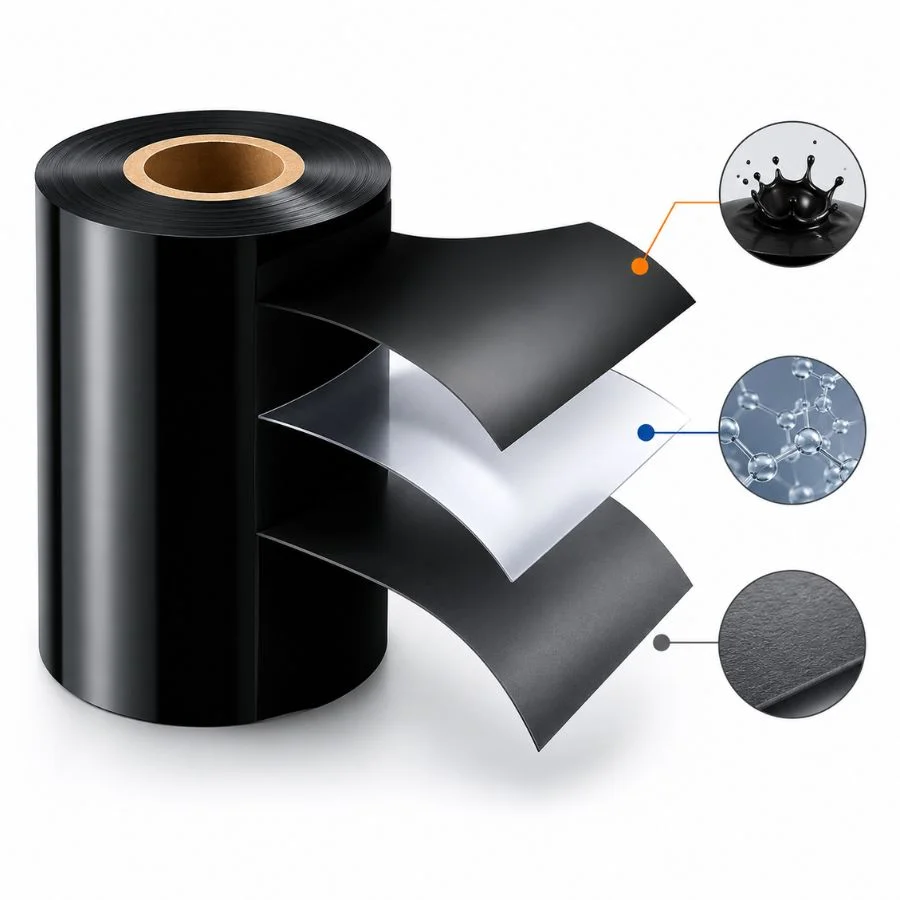
Thermal transfer ribbon composition follows a three-layer structure: a thin polyester (PET) film base, an ink layer of wax, resin, or wax-resin on the front, and a back coating on the reverse side that protects the printhead from heat and friction. The PET base is typically 4.5 to 6 microns thick, thin enough to transfer heat quickly from the printhead while still holding its shape as it winds through the printer at speed. The ink layer is the variable that changes between wax, wax-resin, and resin formulations, while the base film and back coating stay broadly consistent across ribbon grades.
Understanding this thermal transfer ribbon composition matters because each layer affects performance in a different way: the base film determines tensile strength and heat transfer speed, the ink layer determines image durability and substrate compatibility, and the back coating determines how long a printhead lasts before wearing out. A ribbon with a poor back coating can shorten printhead life significantly, even if the ink layer itself performs well. Buyers comparing ribbons on ink formulation alone, without checking back coating quality, often see printhead replacement costs erase any savings from a cheaper roll.
Thermal Transfer Ribbon Types Explained
Thermal transfer ribbon types fall into three core categories: wax, wax-resin, and full resin, each built around a different ink chemistry matched to a different substrate and durability requirement. Wax ribbons melt at the lowest temperature and print well on uncoated paper, wax-resin ribbons add scratch and smudge resistance for coated paper and light synthetics, and full resin ribbons deliver the highest chemical and heat resistance for synthetic films. Selecting among these thermal transfer ribbon types starts with the label facestock, since the wrong ribbon on the wrong substrate produces poor ink anchorage regardless of printer settings.
Specialty variations exist within each category, including near edge ribbons built for high-speed overprinting and textile resin ribbons formulated for wash-care labels that survive industrial laundering. Buyers should match ribbon type to both the facestock and the end-use environment rather than defaulting to whichever ribbon is cheapest or already in stock. A mismatched ribbon type is one of the most common causes of barcode scan failures on a production line.
- Wax ribbon: Lowest cost, uncoated paper, indoor short-term use
- Wax-resin ribbon: Moderate durability, coated paper and light film
- Full resin ribbon: Highest durability, synthetic film, harsh chemical exposure
- Near edge ribbon: High-speed overprinting on flexible packaging
- Textile resin ribbon: Wash-care and garment labeling
Thermal Transfer Ribbon Wax vs Resin: Choosing the Right Formulation
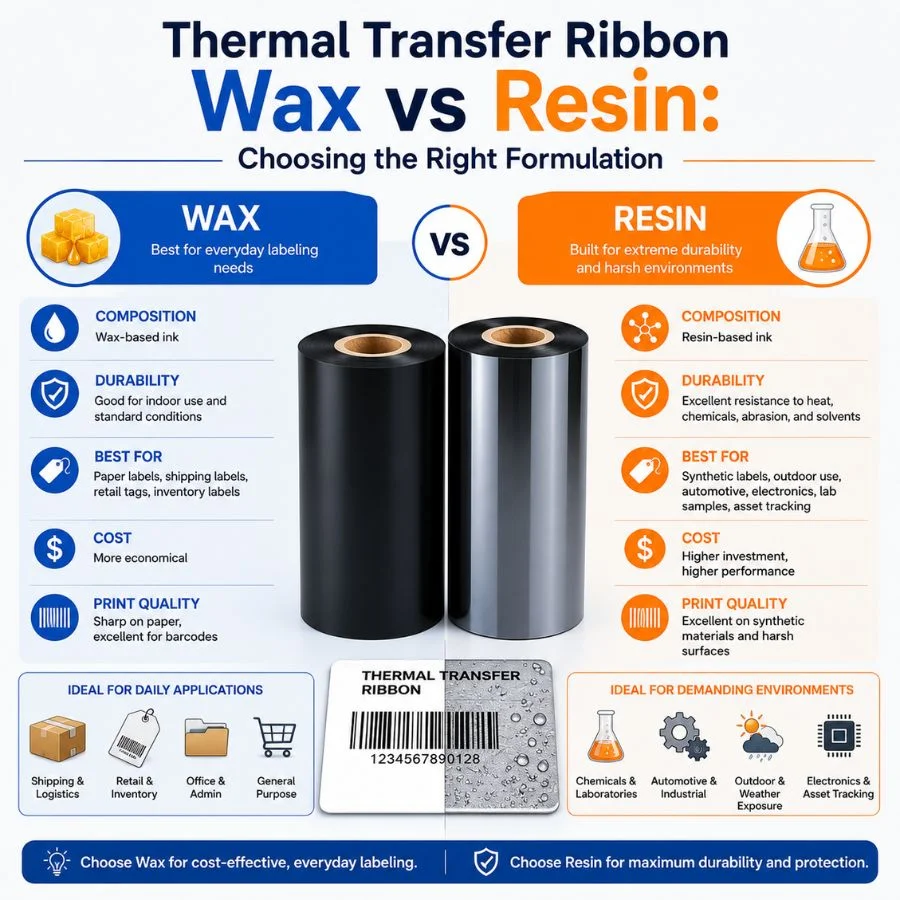
The thermal transfer ribbon wax vs resin decision comes down to substrate compatibility and how long the printed label needs to survive its environment. Wax ribbons melt around 65°C and suit uncoated or matte paper labels used indoors for shipping, retail, and general inventory tracking where the label has a short useful life. Resin ribbons melt above 110°C and bond permanently with polyester, polyimide, and PVC facestocks, giving them the chemical and abrasion resistance needed for asset tags, under-hood automotive labels, and outdoor signage.
Wax-resin formulations sit between these two extremes, offering better smudge resistance than pure wax at a lower cost than full resin, which makes them a common default for coated paper labels in logistics and retail environments. Print speed also differs by formulation, since wax ribbons can run at higher speeds than resin ribbons because resin requires more heat and dwell time to transfer properly. Buyers who default to resin for every application overspend, while buyers who default to wax for harsh environments risk premature label failure.
Wax vs Wax-Resin vs Resin at a Glance
| Ribbon Type | Ink Melting Point | Best Substrate |
|---|---|---|
| Wax | Approximately 65°C | Uncoated paper |
| Wax-Resin | 75°C to 85°C | Coated paper, light film |
| Full Resin | 110°C or higher | Polyester, polyimide, PVC |
What Is Thermal Transfer Ribbon Used For?
Thermal transfer ribbon uses span nearly every industry that relies on barcode traceability, including logistics, automotive manufacturing, electronics, chemical processing, and healthcare labeling. In automotive and aerospace applications, resin ribbons print VIN labels and under-hood tags that must survive engine oils, hydraulic fluids, and continuous heat exposure over a vehicle’s full service life. Electronics manufacturers rely on high-temperature resin ribbons for PCB tracking labels that pass through wave soldering ovens exceeding 260°C without losing barcode legibility.
Chemical processing facilities depend on resin ribbon printing for GHS-compliant drum labels that must stay legible even after exposure to solvents or seawater. Retail and logistics operations more commonly use wax and wax-resin ribbons for shipping labels and shelf tags, where cost efficiency matters more than long-term chemical resistance. Matching the ribbon to its actual use case, rather than buying a single formulation for every job, is the single biggest lever for reducing both waste and reprint costs.
Thermal Transfer Ribbon Colors: Black, Blue, and Beyond
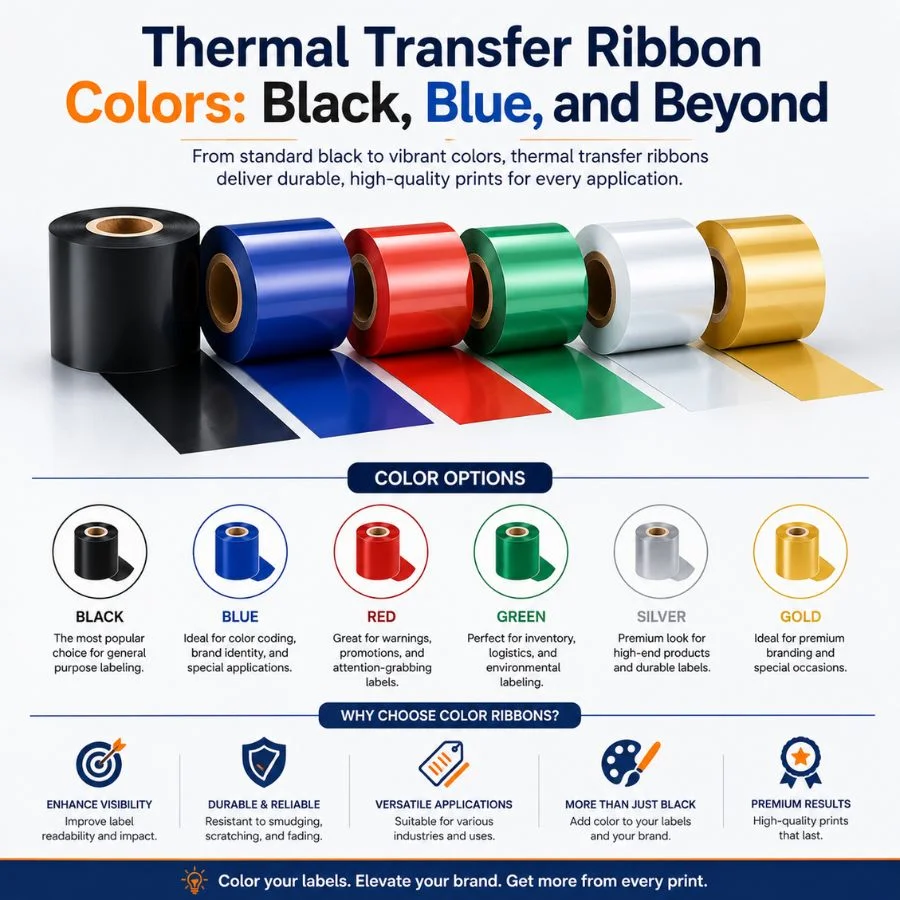
Thermal transfer ribbon black is the standard choice for the overwhelming majority of barcode and text printing because it delivers the highest contrast against white or light-colored facestocks for automated scanner readability. Thermal transfer ribbon blue and other spot colors exist for applications like color-coded inventory systems, date coding, or brand differentiation, though colored ribbons generally cost more and offer fewer chemical-resistance grades than standard black. Thermal transfer ribbon colors beyond black and blue, including red and green, are typically special-order items produced in smaller batches.
Contrast and scanner grade matter more than color choice for any barcode-critical application, since a low-contrast colored ribbon can fail ANSI barcode grading even when the print looks acceptable to the eye. Buyers printing barcodes for compliance-driven industries such as pharmaceuticals or automotive traceability should default to black resin or wax-resin ribbon unless a specific business reason requires color. Reserving colored ribbons for non-critical text, such as internal handling instructions, avoids introducing unnecessary scan risk into the barcode itself.
Thermal Transfer Ribbon Core, Width, and Roll Specifications
Thermal transfer ribbon specifications must match the printer’s design to ensure reliable installation and consistent print quality. The most common ribbon core size for industrial thermal transfer printers is 1 inch (25.4 mm), while many desktop printers use 0.5 inch (12.7 mm) cores. Some printer models support additional core sizes or adapters, so compatibility should always be confirmed before ordering.
Thermal transfer ribbons are available in a wide range of widths, with 40 mm to 110 mm covering many of the most commonly used industrial and desktop label applications. Standard roll lengths frequently include 74 m, 300 m, 450 m, and 600 m, although other lengths are available depending on the printer manufacturer and application. A 110 mm × 300 m black thermal transfer ribbon is among the most widely used configurations for 4-inch industrial flat-head printers producing high-volume barcode and product labels.
Some ribbon manufacturers use internal part numbers, such as B110A or B110CR, to identify specific ribbon formulations or product variants. These SKU formats are not standardized across the thermal printing industry, so buyers should not assume compatibility based on a part number alone. Instead, verify the ribbon’s specifications, including width, length, core size, ribbon formulation, and printer compatibility, before placing an order.
Ribbon winding direction is equally important. Thermal transfer ribbons are manufactured as Coated Side In (CSI) or Coated Side Out (CSO). The winding orientation must match the printer’s ribbon path because a ribbon installed with the wrong coating orientation will generally fail to transfer ink properly onto the label.
Common Thermal Transfer Ribbon Specifications
- Core sizes: Commonly 1 inch (25.4 mm) for industrial printers and 0.5 inch (12.7 mm) for many desktop printers, depending on the printer model.
- Common ribbon widths: 40 mm to 110 mm, with additional specialty widths available for specific applications.
- Common roll lengths: 74 m, 300 m, 450 m, and 600 m, plus other lengths offered by various manufacturers.
- Winding configurations: Coated Side In (CSI) or Coated Side Out (CSO), which must match the printer’s required ribbon orientation.
Thermal Transfer Ribbon Cost and Price Factors
Thermal transfer ribbon cost depends primarily on ink formulation, with wax ribbons priced lowest, wax-resin in the middle, and full resin commanding the highest thermal transfer ribbon price due to its chemical-resistant ink chemistry and higher raw material cost. Roll length, width, and order volume also shift per-roll pricing, since a 600m roll costs proportionally less per meter than a 74m roll from the same production run. Buyers evaluating thermal transfer ribbon cost should calculate cost per printed label rather than cost per roll, since a cheaper wax ribbon that fails and requires reprinting can end up more expensive overall.
Factory-direct sourcing typically holds thermal transfer ribbon price lower than buying through a distributor, since it removes an extra markup layer between the coating line and the buyer. Custom widths, non-standard core sizes, and small production runs generally carry a price premium over standard configurations. Requesting a sample roll before committing to a bulk order remains the most reliable way to confirm both print performance and true cost per label.
Sourcing Thermal Transfer Ribbon Manufacturers and Understanding HS Code Basics
Thermal transfer ribbon manufacturers range from large global consumable brands, including Brady thermal transfer ribbon products used widely in industrial labeling, to factory-direct producers that supply converters and distributors without a trading company markup. Both models have a place in the market, but factory-direct thermal transfer ribbon manufacturers in regions like thermal transfer ribbon China production hubs typically offer lower per-unit pricing on large-volume orders because of proximity to raw film and ink suppliers. Buyers should confirm ISO 9001 manufacturing status, RoHS and REACH compliance, and documented lot traceability before choosing any supplier regardless of brand recognition.
For customs purposes, most thermal transfer ribbon hs code classifications fall under HS heading 9612.10, the global category covering typewriter and similar ribbons, though the exact subheading can vary slightly by country and ribbon construction. Import teams should confirm the applicable code with their customs broker rather than assuming a single code applies universally, since misclassification can delay shipments or trigger reclassification. Vizlent manufactures thermal transfer barcode ribbons in wax, wax-resin, and full resin formulations, shipping factory-direct from China to converters and distributors worldwide.
Get Thermal Transfer Ribbons Backed by Factory-Direct Support
Choosing the right ribbon starts with matching ink formulation, width, core size, and roll length to your printer and label material, and a knowledgeable supplier makes that process far easier. Vizlent manufactures thermal transfer ribbons in wax, wax-resin, and full resin formulations, factory-direct from an ISO 9001 certified facility, with RoHS and REACH compliant materials shipped worldwide. Send an inquiry to request free sample rolls and technical specification sheets for your printer model, or explore Vizlent’s label stock range to complete your full print system.
Frequently Asked Questions
What is thermal transfer ribbon?
The answer comes down to a simple definition: it is a coated film loaded with wax, resin, or wax-resin ink that a thermal printhead melts onto a label to create a permanent, durable print. The ribbon is consumed as it prints, transferring ink in the exact shape of each barcode, letter, or graphic before winding onto a take-up spool inside the printer. This basic mechanism is the starting point for choosing the correct type, since wax, wax-resin, and resin formulations perform very differently across substrates and environments.
Does thermal transfer use ribbon?
Yes, thermal transfer printing always uses a ribbon, and that ribbon is the defining feature separating it from direct thermal printing, which prints directly onto heat-sensitive paper with no ribbon involved. The ribbon carries the ink that gets melted and transferred onto the label facestock during printing. Direct thermal labels fade over time from heat and UV exposure, while thermal transfer labels remain stable because the ink is physically bonded to the surface.
What is the difference between thermal transfer ribbon wax vs resin?
Thermal transfer ribbon wax vs resin comes down to melting point and durability, with wax ribbons melting around 65°C for economical printing on paper and resin ribbons melting above 110°C for chemical and heat resistance on synthetic films. Wax-resin sits in between, offering a durability upgrade over wax without the full cost of resin. The correct choice depends on the label’s facestock material and how long the print needs to survive in its intended environment.
What is a typical thermal transfer ribbon price range?
Thermal transfer ribbon price varies by formulation, with wax ribbons the least expensive, wax-resin in the middle tier, and full resin ribbons commanding the highest cost due to specialty ink chemistry. Roll length and order volume also affect price per roll, with longer rolls and bulk orders typically reducing the cost per meter. Requesting a sample and calculating cost per printed label, rather than comparing roll prices alone, gives the most accurate view of true cost.
What thermal transfer ribbon core size do I need?
Most industrial thermal transfer ribbon printers use a 1 inch ribbon core, while many desktop and mobile printers use a 0.5 inch core, so confirming your printer’s spindle size before ordering is essential. Ordering the wrong core size means the ribbon cannot be mounted on the printer at all, regardless of how well the ink formulation matches the label. Checking the printer manual or the original ribbon packaging is the fastest way to confirm the correct core size.
Are brady thermal transfer ribbon products compatible with other printer brands?
Most brady thermal transfer ribbon products are designed for Brady-branded printers first, though many industrial ribbons across brands share similar core sizes, widths, and printhead technology that allow broader cross-brand compatibility. Buyers switching away from a single-brand ecosystem should confirm core size, width, and winding configuration against their specific printer model before ordering. Factory-direct manufacturers can often match these specifications closely while offering more flexible customization than single-brand consumable programs.
Where are most thermal transfer ribbon manufacturers based?
A large share of global thermal transfer ribbon manufacturers operate out of thermal transfer ribbon China production hubs, where proximity to PET film and ink raw materials supports competitive factory-direct pricing. Manufacturers elsewhere in Asia, Europe, and North America also produce ribbons, often focusing on specialty formulations or regional distribution rather than raw production volume. Buyers should evaluate manufacturing certifications and sample performance rather than country of origin alone when selecting a supplier.






