
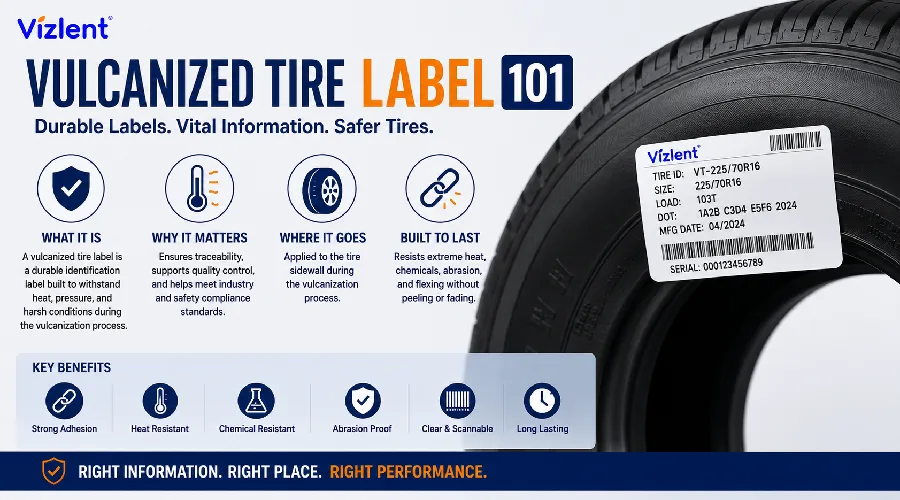
A vulcanized tire label is a barcode identification tag that bonds permanently into rubber during the tire curing process instead of sticking on with adhesive. It survives curing temperatures above 200°C, resists sulfur curing agents and silicone mold releases, and stays scannable for the full service life of the tire. Manufacturers apply the label to the green, uncured tire before the curing press seals the tread and sidewall into their final shape. The sections below cover what a vulcanized tire is, how tire vulcanizing works, and what buyers should confirm before choosing a supplier.
What Is a Vulcanized Tire?
A vulcanized tire is a rubber tire that has been heated under pressure with sulfur to cross-link its rubber molecules into a strong, elastic structure. This process, called tyre vulcanizing, transforms soft, tacky green rubber into the durable, heat-stable compound that grips the road and holds air pressure. Charles Goodyear discovered the basic chemistry in 1839, and tire manufacturers still rely on the same sulfur cross-linking principle today, refined with modern accelerators and molds.
Before vulcanization, a tire existed as an uncured assembly of rubber plies, steel belts, and bead wire known in the industry as a green tire. Once the green tire enters the curing press, heat and pressure activate the sulfur bonds and lock the tire into its final tread pattern and sidewall profile. Any label applied at this stage must survive the same heat and pressure that transforms the rubber itself, which is exactly the job this label type is built to do.
Understanding tyre vulcanizing matters for anyone sourcing identification labels, because the chemistry of the cure dictates every material property the label must have. A facestock that cannot withstand sulfur cross-linking temperatures fails before the tire itself is finished. That single requirement separates general-purpose barcode labels from purpose-built curing labels almost entirely on material science rather than adhesive strength.
Vulcanized Tire Meaning in Tire Manufacturing
The vulcanized tire meaning in a production plant is narrower than the general definition. On the factory floor, “vulcanized” refers specifically to the curing step where a molded green tire becomes a finished, saleable product with its final physical and chemical properties locked in. Quality teams treat this step as the single most critical control point in the entire manufacturing line.
Traceability through this step matters because a batch defect discovered after curing is far more costly than one caught before. A Vulcanized Tire Label carries the batch number, production date, and compliance data that lets a plant trace a finished tire back to its exact curing cycle. Without that label surviving the press intact, recall management and DOT compliance records lose their link to the physical product.
How a Vulcanized Tire Label Survives the Curing Press
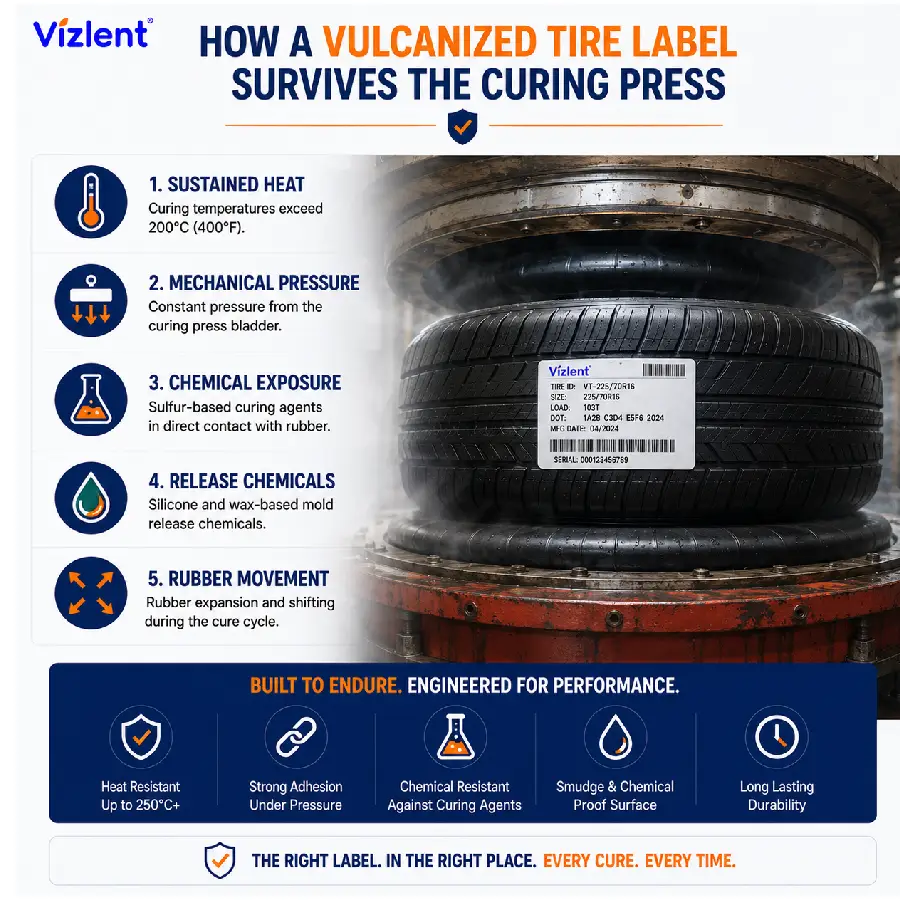
Standard pressure-sensitive labels rely on adhesive tack, and adhesive tack fails under sustained heat above roughly 150°C. This label type avoids that failure mode entirely by chemically cross-linking with the rubber itself during co-vulcanization, becoming part of the tire bead or inner liner rather than sitting on top of it. The bond forms inside the same curing press cycle that vulcanizes the rest of the tire, so no separate application step is needed.
Engineered facestocks used in this construction are built from high-temperature polymers rated for sustained exposure well past 200°C without melting, burning, or discoloring. The facestock also resists sulfur curing agents and the silicone-based mold release compounds used throughout the pressing cycle. These properties are why converters specify vulcanized construction rather than standard adhesive labels for any identification tag that must exist inside the mold.
Print method compatibility matters just as much as the facestock itself. Thermal transfer printing paired with a high-durability resin ribbon is the only combination that reliably survives curing press conditions, since direct thermal and inkjet printing both degrade under sustained heat. Converters who pair the wrong print method with an otherwise correct facestock still lose barcode legibility, which is why supplier consultation on the full print stack matters as much as the label material choice.
Conditions a Vulcanized Tire Label Must Withstand
- Sustained curing temperatures exceeding 200°C (400°F)
- Mechanical pressure from the curing press bladder
- Sulfur-based curing agents in direct contact with rubber
- Silicone and wax-based mold release chemicals
- Rubber expansion and shifting during the cure cycle
| Feature | Standard Adhesive Label | Vulcanized Tire Label |
|---|---|---|
| Bonding method | Pressure-sensitive adhesive | Chemical cross-linking with rubber |
| Max sustained heat | Approximately 150°C | Above 200°C |
| Removability | Can peel or lift | Permanent, cannot be removed intact |
| Typical use stage | After tire is finished | Applied to green tire before curing |
| Chemical resistance | Limited | High resistance to sulfur agents and mold release |
Barcode Design and Vulcanized Tire Label Color
Barcode integrity is the entire point of applying a label before curing, so vulcanized tire label design starts with a dimensionally stable facestock that resists stretching as the green tire expands under press pressure. A distorted barcode after cure is unreadable to automated scanners, which defeats the traceability purpose of the label in the first place. Engineered facestocks hold their proportions through the cure cycle so 1D and 2D codes stay within scannable tolerances.
Vulcanized tire label color is typically limited to white, black, or natural facestock tones because pigmented topcoats must survive the same thermal exposure as the barcode print itself without shifting or fading. Print contrast, not decorative color, drives every design choice on this label type. High-resolution thermal transfer printing paired with a premium resin ribbon is the standard combination for producing crisp, chemical-resistant barcode data.
Font size, quiet zone spacing, and code density also factor into vulcanized tire label design because scanners on a production line need consistent read rates at speed. A 1D barcode with generous quiet zones tends to outperform a dense 2D code on labels destined for high-vibration curing environments, though many manufacturers now specify both formats for redundancy. Design decisions made at this stage carry through the entire service life of the tire, since the label cannot be reprinted or replaced once it is cured into the rubber.
Vulcanized Tire Label Cost Factors
Vulcanized tire label cost depends on facestock grade, adhesive-free bonding chemistry, print method, and order volume rather than a flat per-unit price. High-temperature polymer facestocks and specialty topcoats cost more per label than standard pressure-sensitive stock, but they eliminate the scrap and rework costs of labels that fail inside the press. Buyers evaluating vulcanized tire label cost should weigh total cost of ownership against the price of a single failed curing cycle.
Order volume, custom sizing, and resin ribbon compatibility also shift the final price per roll. A factory-direct manufacturer can typically hold vulcanized tire label cost lower than a trading company by removing a layer of markup between the coating line and the buyer. Requesting a sample run before committing to a bulk order is the most reliable way to confirm cost against real production performance.
- Facestock grade and high-temperature polymer content
- Adhesive-free bonding chemistry and topcoat formulation
- Print method and resin ribbon compatibility
- Custom sizing, die-cutting, and roll configuration
- Order volume and minimum order quantity
- Sample and compatibility testing before bulk commitment
Choosing Vulcanized Tire Label Brands and Dealers
Not all vulcanized tire label brands source facestock and adhesive chemistry to the same standard, so buyers should confirm ISO 9001 manufacturing, UL 969 compliance, and documented curing-temperature test data before placing an order. Reputable vulcanized tire label brands publish technical specifications rather than vague marketing claims, and they support buyers with sample rolls for compatibility testing on an actual curing press. A brand that cannot supply test data for its own product is not a brand worth building a supply chain around.
Vulcanized tire label dealers add a layer of distance between the buyer and the factory that produced the material, which can slow down technical support and custom specification requests. Working directly with a manufacturer instead of vulcanized tire label dealers typically shortens lead times and gives engineering teams direct access to the people who formulated the facestock. Vizlent supplies Vulcanized Tire Labels factory-direct to converters and distributors, with technical support available at every stage of specification.
Vulcanized Tire Label Decal Applications Beyond New Tire Production
The term vulcanized tire label decal is sometimes used interchangeably with vulcanized tire label, though the underlying construction is the same permanently bonded, co-cured tag rather than a surface-applied decal. Commercial tire retreading is the largest secondary application, since retreaded truck and bus tires pass through a second curing cycle in an autoclave or press that demands the same heat and chemical resistance as original production. A vulcanized tire label decal used in retreading must survive that second cure exactly as it survived the first.
Industrial rubber products outside tires, including hoses, gaskets, and conveyor belts, use the same co-vulcanization principle for permanent identification. Any application where a rubber component is cured under heat and pressure is a candidate for this style of construction rather than a standard adhesive tag. Vizlent’s Automotive Labels line covers this broader range of heat-cured and under-hood identification needs, and pairs naturally with Vizlent’s Resin Ribbon products for print durability.
Understanding Vulcanized Tire Label Requirements
A vulcanized tire label is designed for one of the most demanding identification environments in manufacturing. During the curing process, the label must remain intact while exposed to high temperatures, pressure, and rubber compounds that would quickly damage conventional labels. Reliable performance depends on selecting materials that maintain adhesion, preserve print quality, and resist distortion throughout production.
Choosing the right vulcanized tire label starts with the application’s curing conditions. Tire manufacturers and retread facilities typically evaluate heat resistance, chemical compatibility, barcode readability, and dimensional stability before approving a label for production. These characteristics help ensure every tire remains accurately identified from manufacturing through storage, shipping, and inventory management.
Not every vulcanized tire label is built to the same specification. Material construction, adhesive technology, and print performance all influence how the label performs during vulcanization. A label engineered for demanding curing environments supports product traceability, reduces identification errors, and delivers consistent results across high-volume manufacturing operations.
Get Vulcanized Tire Labels Backed by Factory-Direct Support
A Vulcanized Tire Label is only as reliable as the facestock, adhesive-free bonding chemistry, and factory quality control behind it. Vizlent manufactures tire curing labels and the broader Vulcanized Labels range factory-direct, backed by ISO 9001 processes and technical support for converters and distributors worldwide. Send an inquiry to request sample rolls and curing-press test data for your specification, or explore Vizlent’s Thermal Transfer Ribbons to complete your barcode printing setup.
Frequently Asked Questions
What is a vulcanized tire?
A vulcanized tire is a rubber tire that has been chemically cross-linked with sulfur under heat and pressure to reach its final strength and elasticity. This curing step, known as tyre vulcanizing, converts soft green rubber into a stable compound that holds its molded tread pattern. Nearly every tire on the road today, from passenger vehicles to commercial trucks, goes through this same vulcanization process.
What is tyre vulcanizing?
Tyre vulcanizing is the manufacturing step where a molded green tire is heated under pressure inside a curing press to activate sulfur cross-linking in the rubber compound. The process typically runs at temperatures above 150°C and locks the tire into its final tread, sidewall, and bead geometry. Any identification label applied before this step, such as a Vulcanized Tire Label, must be engineered to survive the same conditions.
What is the vulcanized tire meaning in a barcode or tracking context?
In a tracking context, the vulcanized tire meaning refers to a label or tag that has been permanently bonded into the rubber during curing rather than applied afterward with adhesive. This distinction matters for traceability because a vulcanized tag cannot be removed, swapped, or lost the way an adhesive label sometimes can. It gives manufacturers a tamper-proof link between a physical tire and its production record.
What is a vulcanized tire label barcode used for?
A vulcanized tire label barcode carries batch numbers, production dates, and compliance data that support DOT traceability, recall management, and supply chain tracking. It is printed using thermal transfer technology paired with a resin ribbon so the code survives the same heat and chemical exposure as the label substrate. Automated scanners read this barcode at multiple points across the tire’s production and service life.
How much does a vulcanized tire label cost compared to a standard adhesive label?
Vulcanized tire label cost typically runs higher per unit than a standard adhesive barcode label because of the specialty high-temperature facestock and coating required. That higher unit cost is offset by eliminating the scrap, rework, and traceability gaps caused by adhesive labels failing inside the curing press. Buyers should request a sample order to compare real-world cost against production performance.
Can a vulcanized tire label decal be used in tire retreading?
Yes, a vulcanized tire label decal is well suited to retreading because retreaded commercial tires pass through a second heat-and-pressure curing cycle in an autoclave or press. The same high-temperature facestock and chemical resistance that protects the label during original production protects it through the retread cure as well. This makes vulcanized construction the standard choice for tracking heavy-duty truck and bus tires across multiple service lives.
How do I choose between vulcanized tire label dealers and a direct manufacturer?
Choosing a direct manufacturer over vulcanized tire label dealers generally shortens lead times, reduces cost markup, and gives buyers direct access to engineering support for custom specifications. Dealers can be useful for smaller trial orders or regional stock, but they add a layer of communication between the buyer and the factory that produced the material. Requesting documented test data and sample rolls is the best way to evaluate any vulcanized tire label brands or dealers before committing to a bulk order.
Do vulcanized tire label brands offer custom sizes and shapes?
Most established vulcanized tire label brands support custom die-cutting, sizing, and roll configuration to match specific bead or inner liner placement requirements. Custom sizing typically requires a minimum order quantity and a short lead time for tooling, though factory-direct suppliers can often accommodate trial runs at lower volumes. Confirming die-cutting capability early in the sourcing process avoids delays once production scheduling begins.






