
Most waterproof labels are not biodegradable, because the same plastic facestocks and synthetic adhesives that block water also resist natural decomposition. A small group of specialized manufacturers, including Vizlent, now produce waterproof labels biodegradable enough to break down under industrial composting conditions while still surviving moisture, humidity, and surface contact. The honest answer depends entirely on the facestock, the adhesive chemistry, and the certification behind the product you choose.
This distinction matters more than most buyers expect, since a label marketed as “eco-friendly” can still fail every recognized compostability standard. Understanding the materials science behind waterproofing and biodegradation lets brand owners specify the right stock with confidence. Below, Vizlent’s engineering team breaks down what makes a label waterproof, why that often conflicts with biodegradability, and how a handful of capable suppliers solve the trade-off.
What Makes a Label Waterproof in the First Place
A waterproof label resists moisture because its facestock and adhesive form a barrier that water cannot penetrate or weaken. Traditional waterproofing relies on synthetic films such as Biaxially oriented polypropylene (BOPP), Polyethylene terephthalate (PET), Polyvinyl chloride (PVC), or vinyl, which repel liquid by their molecular structure rather than by any coating alone. These plastics hold ink, maintain adhesion, and stay legible even after prolonged submersion, condensation, or freezer storage.
The adhesive layer carries equal weight in this performance, since a water-repellent facestock fails if the glue beneath it dissolves. Most waterproof labels for packaging use permanent acrylic or rubber-based adhesives engineered to bond through wet application and humid storage. This combination of plastic film and moisture-resistant adhesive is precisely what makes the question of biodegradability so difficult to answer.
Several construction features determine how well a label survives wet environments:
- Facestock material, where films like PET and BOPP outperform standard paper in saturation resistance
- Adhesive chemistry, since acrylic and rubber bonds hold under moisture while water-based glues may soften
- Topcoat and lamination, which protect printed ink from smearing or fading on contact with liquid
Why Waterproof and Biodegradable Usually Conflict
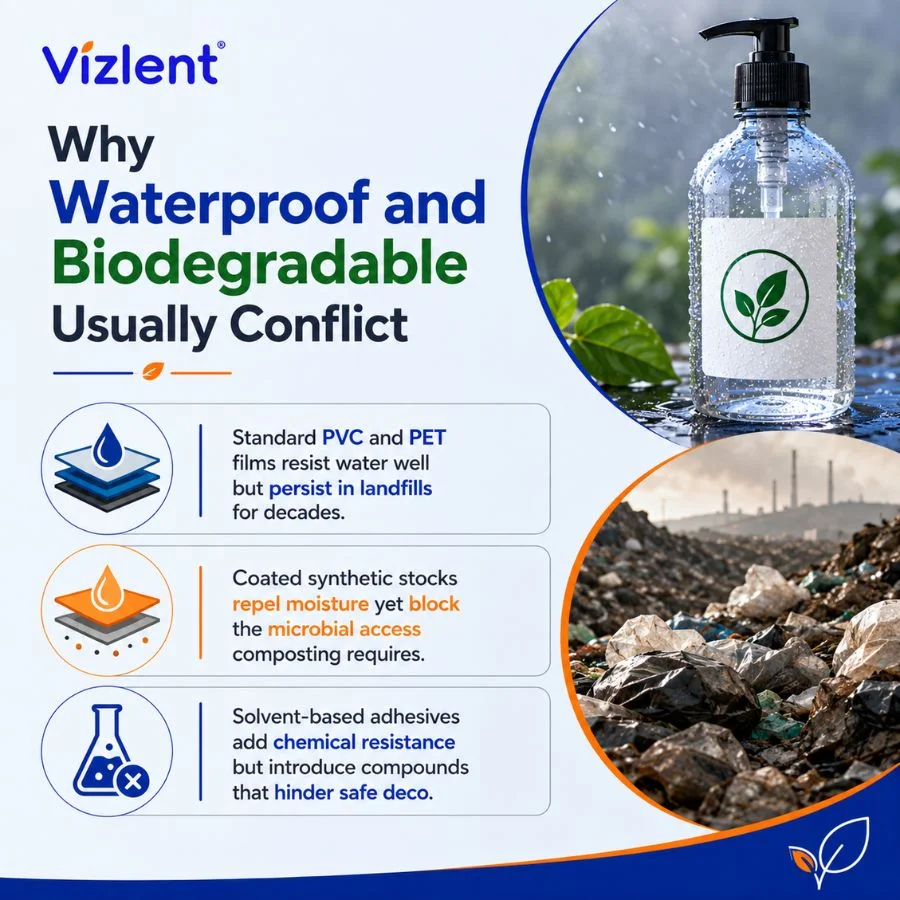
Waterproofing and biodegradability sit in natural tension, because durability against water often means durability against the microbes that drive decomposition. The synthetic polymers that block moisture, such as conventional PET and PVC, are designed to last for decades and resist the bacterial and fungal activity that breaks organic matter down. A material engineered to survive years of outdoor exposure is, by definition, slow to return to the earth.
This is the core reason most waterproof labels for product packaging never qualify as compostable or biodegradable. The same resistance that protects a wine bottle label through ice-bucket condensation also prevents that label from breaking down in soil or a composting facility. Buyers who assume any sturdy label can be “green” often overlook this fundamental materials conflict.
The friction shows up clearly across common label types:
- Standard PVC and PET films resist water well but persist in landfills for decades
- Coated synthetic stocks repel moisture yet block the microbial access composting requires
- Solvent-based adhesives add chemical resistance but introduce compounds that hinder safe decomposition
What “Biodegradable” Actually Means for Labels
Biodegradable means a material can be broken down by microorganisms into water, carbon dioxide, and biomass within a defined timeframe and environment. For labels, this term is meaningless without certification, since almost anything degrades eventually under the right conditions. Recognized standards like EN 13432 and ASTM D6400 set strict thresholds for how completely and how quickly a material must decompose to earn the claim.
True waterproof biodegradable labels must satisfy these standards across the entire construction, not just the facestock. A compostable paper face bonded with a non-degrading acrylic adhesive does not meet the requirement, because the adhesive residue persists. This is why credible manufacturers certify the full label system, including face material, adhesive, and any coatings, rather than a single component.
Key certification benchmarks buyers should request include:
- EN 13432, the European standard for industrial compostability of packaging
- ASTM D6400, the North American specification for compostable plastics
- TÜV OK Compost, a third-party verification covering full-construction compostability
Explore Vizlent’s certified biodegradable label range to see which constructions carry recognized compostability documentation.
How a Few Manufacturers Make Waterproof Labels Biodegradable
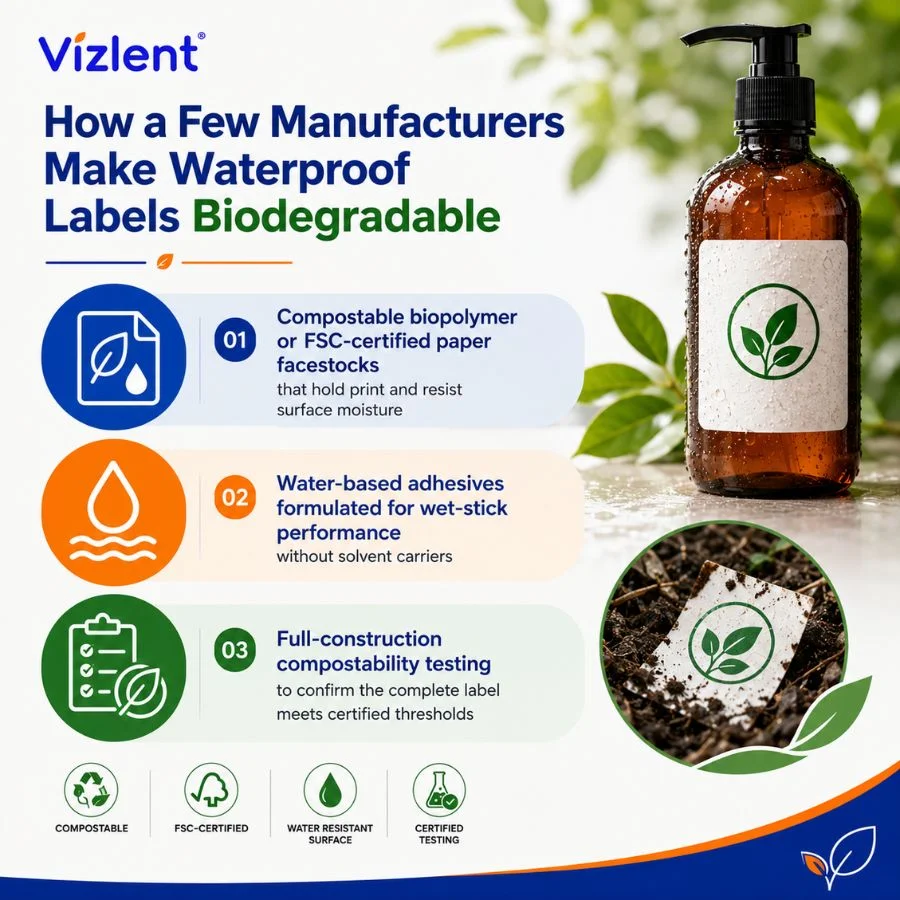
A small number of capable manufacturers produce waterproof labels biodegradable enough to pass certification by reformulating both the facestock and the adhesive. Vizlent achieves this using compostable face stocks paired with water-based adhesives that resist moisture during use yet break down under industrial composting conditions. The result is a label that withstands handling, condensation, and humidity without the decades-long persistence of conventional plastic.
This balance is technically demanding, which is why so few suppliers offer it credibly. Engineering a waterproof eco friendly labels solution requires controlling coat weight, adhesive anchorage, and facestock barrier properties simultaneously, then validating the full system against EN 13432 or ASTM D6400. Vizlent’s in-house coating and lab-testing capability makes this level of control possible at production scale rather than as a one-off sample.
The materials approach typically combines:
- Compostable biopolymer or FSC-certified paper facestocks that hold print and resist surface moisture
- Water-based adhesives formulated for wet-stick performance without solvent carriers
- Full-construction compostability testing to confirm the complete label meets certified thresholds
This is the central reason not all sustainable labels are equal, and why sourcing waterproof labels biodegradable to a verified standard means working with a specialized manufacturer. Request a free sample of Vizlent’s biodegradable stock to validate performance on your own line.
The Fruit Label Example: Why Not All Are Compostable
Fruit stickers illustrate the gap between assumed and actual compostability better than almost any product. Billions of produce labels enter compost and recycling streams each year, yet the majority use conventional plastic films and acrylic adhesives that never break down. Despite ending up on organic waste, most fruit labels are not compostable and contaminate compost batches at processing facilities.
Only a few capable adhesive label manufacturers, Vizlent among them, produce genuinely compostable fruit labels certified to recognized standards. These specialized stocks use biopolymer facestocks and compostable adhesives that decompose alongside the fruit peel rather than persisting as microplastic. The difference is invisible to the eye, which is exactly why certification documentation matters more than marketing language.
Buyers evaluating produce or food labels should confirm:
- Whether the facestock is a certified biopolymer rather than standard BOPP or PET
- Whether the adhesive itself is compostable, since many “eco” labels keep a conventional glue
- Whether full-construction certification exists under EN 13432 or an equivalent benchmark
Choosing the Right Waterproof Label for Your Application
Selecting the correct label starts with defining your environment, your end-of-life goal, and your regulatory requirements. A brand shipping frozen goods needs different performance than one labeling reusable glass, and a company targeting compostability has different constraints again. Matching the facestock and adhesive to the real-world exposure prevents both premature failure and false sustainability claims.
For most B2B buyers, the decision reduces to a clear set of priorities that a knowledgeable manufacturer can translate into a specification. Vizlent’s engineering team works directly from your application details to recommend the right construction, whether you need waterproof labels for bottles, waterproof labels for bags, or fully certified compostable stock. This consultative approach avoids the common mistake of buying durable plastic when a compostable system would have met the same functional needs.
Common application categories and their typical material logic include:
- Waterproof labels for bottles that face condensation and ice-bath immersion, favoring PET or compostable film with strong wet-stick adhesive
- Waterproof labels for bags in retail and logistics, where flexibility and abrasion resistance guide facestock choice
- Waterproof labels custom to brand specifications, balancing print finish, durability, and end-of-life requirements
If sustainability is a priority, ask specifically for waterproof labels biodegradable to a named standard rather than accepting a vague eco claim. Send your specifications to Vizlent for a tailored material recommendation within 24 hours.
Printing, Sourcing, and Practical Buying Considerations
Print compatibility and sourcing logistics shape your label choice as much as the materials science does. Many buyers need waterproof labels for printer use in-house, which requires facestocks topcoated for inkjet or laser output rather than industrial flexo presses. Confirming that a stock is waterproof labels printable on your specific equipment prevents smudging, poor ink anchorage, and wasted runs before a single roll ships.
Sourcing decisions also involve volume, lead time, and supplier capability, especially for buyers comparing local and overseas options. Searching for waterproof labels near me often returns converters who buy their stock from upstream manufacturers, while ordering waterproof labels bulk directly from a factory like Vizlent improves both price and specification control. For sustainability-focused brands, factory-direct sourcing also makes it easier to verify certification on waterproof labels biodegradable and waterproof constructions rather than relying on a reseller’s assurances.
Practical buying factors worth confirming before you order include:
- Printer compatibility, ensuring the stock suits your inkjet, laser, or thermal transfer equipment
- Minimum order quantity and lead time, which factory-direct supply typically improves for waterproof labels bulk orders
- Certification documentation, requested in writing for any waterproof labels biodegradable claim
For bottle-specific projects, confirm that the chosen stock handles immersion and condensation, since waterproof labels bottle applications fail fast when adhesive or facestock is underspecified. Vizlent supplies certified, print-ready stock for exactly these demands. Explore Vizlent’s full self-adhesive material range to match your printing and durability needs.
Specify the Right Label With Vizlent
Choosing between durability and biodegradability no longer means compromising on either, provided you work with a manufacturer that engineers both into a certified construction. Vizlent’s in-house coating, formulation, and lab-testing capability lets brand owners source waterproof labels biodegradable to recognized standards alongside conventional high-performance stock. Whether your priority is moisture resistance, compostability, or both, the right specification starts with a conversation about your real application.
Vizlent supplies factory-direct, ISO 9001, FSC, and SGS-certified label stock to over 1,000 customers across 50+ countries, with free samples and 7 to 15 day lead times on custom orders. The engineering team reviews your facestock, adhesive, and end-of-life requirements within 24 hours and recommends the optimal construction. Move from uncertainty to a verified, print-ready label built for your exact needs.
- Explore certified biodegradable labels for compostable, moisture-resistant constructions
- Send your specifications for a tailored material recommendation and free sample
- Learn more about Vizlent and our 15 years of self-adhesive manufacturing expertise
Frequently Asked Questions
Are waterproof labels biodegradable?
Most waterproof labels are not biodegradable, because conventional plastic facestocks and synthetic adhesives resist the microbial decomposition that biodegradation requires. Only a small group of specialized manufacturers, including Vizlent, produce waterproof labels biodegradable enough to meet certified standards like EN 13432. These use compostable facestocks and water-based adhesives that withstand moisture during use yet break down in industrial composting. Always request certification documentation to confirm any biodegradable claim.
What is the difference between waterproof and biodegradable labels?
Waterproof labels resist moisture and stay legible when wet, while biodegradable labels break down into natural compounds under defined conditions. The two properties often conflict, since the plastics that block water also resist decomposition. Achieving both requires specialized waterproof biodegradable labels that pair compostable facestocks with moisture-resistant, compostable adhesives. Few manufacturers can deliver this balance at production scale with verified certification.
Are fruit labels compostable?
Most fruit labels are not compostable, despite ending up in organic waste, because they use conventional plastic films and acrylic adhesives. Only a few capable manufacturers, such as Vizlent, produce certified compostable fruit labels using biopolymer facestocks and compostable adhesives. These decompose alongside fruit peel rather than persisting as microplastic in compost. Checking for EN 13432 or ASTM D6400 certification confirms genuine compostability.
Can I print waterproof labels on my own printer?
Yes, many waterproof stocks are formulated as waterproof labels for printer use on inkjet or laser equipment. The facestock must carry a compatible topcoat so ink anchors properly and resists smearing when wet. Confirming a stock is waterproof labels printable on your specific machine prevents failed runs. Vizlent supplies print-ready facestocks matched to common in-house and industrial printing methods.
What certifications should biodegradable labels carry?
Credible biodegradable labels should carry full-construction certification such as EN 13432, ASTM D6400, or TÜV OK Compost. These standards verify that the entire label, including facestock and adhesive, decomposes within defined timeframes and conditions. A compostable face paired with a non-degrading adhesive does not qualify. Always request certification covering the complete construction rather than a single component.
Are waterproof labels for packaging recyclable?
Some waterproof labels for packaging are recyclable, but it depends on the facestock and the recycling stream involved. Conventional PET and BOPP films may be recyclable where infrastructure exists, while compostable biopolymer stocks follow a different end-of-life path. Mixing the two without clear labeling can contaminate either stream. Vizlent advises buyers on the appropriate end-of-life route for each material choice.
Where can I buy certified waterproof biodegradable labels in bulk?
You can source certified waterproof labels biodegradable and waterproof constructions directly from a manufacturer like Vizlent, which improves both price and specification control. Factory-direct ordering of waterproof labels bulk also makes certification verification easier than buying through resellers. Vizlent offers free samples so you can validate performance before committing to a production run. Submit your specifications for a tailored quote within 24 hours.
Do biodegradable labels cost more than standard waterproof labels?
Biodegradable waterproof labels typically carry a modest premium over conventional plastic stock, reflecting specialized facestocks and compostable adhesives. The gap narrows with factory-direct sourcing and higher volumes. For brands with sustainability commitments or regulatory requirements, the certified compliance often justifies the difference. Vizlent provides transparent factory-direct pricing on both standard and biodegradable constructions.






