
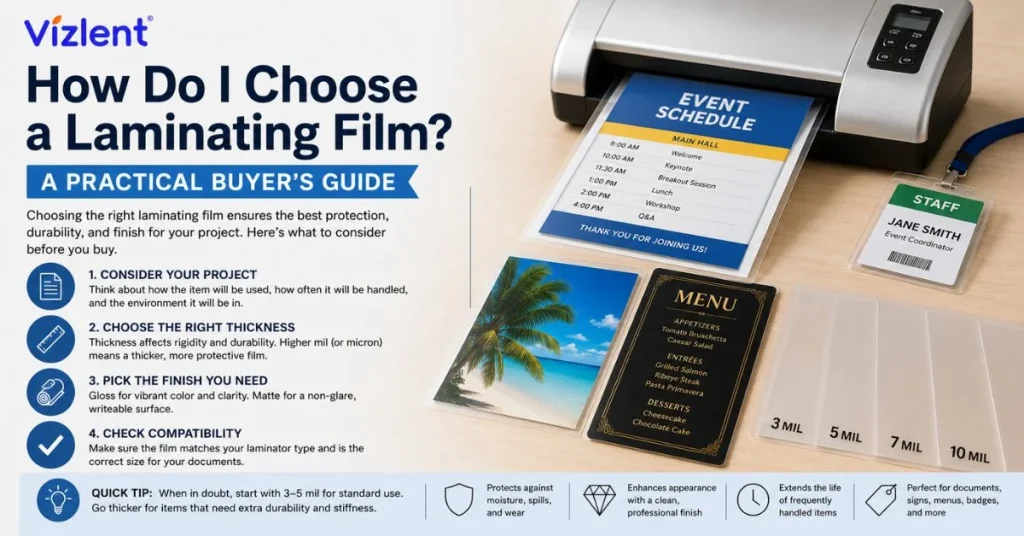
To choose a laminating film, match four things to your project: the lamination method (hot or cold), the film thickness in mil or micron, the finish, such as glossy or matte, and the format you need, either a roll or sheets. The right film protects a print from scratches, moisture, and fading without warping it or clouding the color underneath. Get those four factors right and the film does its job for years, indoors or out.
Sourcing film in bulk for a print shop or packaging line? Request a factory-direct quote from Vizlent and get a film spec matched to your exact application.
Hot Lamination or Cold Lamination: Start Here
The first choice is the lamination method, because it shapes every decision after it. Hot, or thermal, lamination uses heat to bond the film to the print, which suits standard paper documents and high-volume office work. Cold lamination uses a pressure-sensitive adhesive instead of heat, so it protects heat-sensitive prints, inkjet photos, and vinyl without risk of warping.
Your printer and substrate usually point to the answer. If your prints use toner on plain paper, thermal film is fast and economical, while solvent or inkjet graphics call for a cold film that will not cook the ink. A reputable manufacturer can supply both, along with the glue chemistry that fits your surface.
Speed and equipment cost also separate the two methods in daily use. Thermal laminators need warm-up time and draw more power, yet they run quickly once hot and handle long batches well. Cold systems start instantly and stay gentle on delicate media, which makes them a safe default when you are unsure how a print will react to heat.
| Factor | Hot (Thermal) Film | Cold (Pressure-Sensitive) Film |
|---|---|---|
| Bonding method | Heat and pressure | Adhesive and pressure |
| Best for | Toner and paper documents | Inkjet, vinyl, solvent prints |
| Heat risk to print | Possible on sensitive media | None |
| Warm-up time | Required | None |
| Typical use | Offices, schools, books | Signage, photos, vehicle wraps |
Pick the Right Film Thickness for the Job

Thickness decides how rigid and durable the finished piece feels. Laminating film is measured in mil or micron, and a higher number means a thicker, stiffer, more protective layer. Thin films keep documents flexible, while thick films give menus, signs, and ID cards a sturdy, premium feel.
Use the project to guide the gauge rather than defaulting to the thickest option. Light protection for handouts needs far less film than a tabletop sign that takes daily abuse. These ranges give a practical starting point for most buyers:
- 3 mil (75 micron): flexible protection for menus, instructions, and frequently handled sheets
- 5 mil (125 micron): a balanced, semi-rigid choice for signs, ID badges, and reference cards
- 7 mil (175 micron): stiff protection for place mats, tags, and durable reference materials
- 10 mil (250 micron): heavy-duty protection for luggage tags, identification cards, and other high-wear applications
Micron equivalents are approximately 75 micron for 3 mil, 125 micron for 5 mil, 175 micron for 7 mil, and 250 micron for 10 mil.
Thicker is not automatically better, since gauge changes how a piece behaves. A document meant to fold or flex may become difficult to handle and can develop creases or stress marks if you over-laminate it with a stiff film. Choose the lowest thickness that still delivers the protection and feel the project actually needs.
Glossy, Matte, or Satin: Choosing the Finish
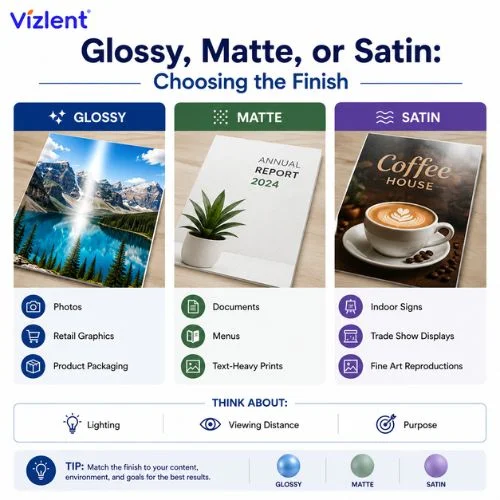
Finish controls how the laminated surface looks and handles light. A laminating film with a glossy finish boosts color, contrast, and shine, which makes it the popular pick for photos, retail graphics, and product packaging. Matte cuts glare and resists fingerprints, so it reads cleanly under bright lights and on documents people handle often.
Satin sits between the two and offers a soft sheen with reduced reflection. Think about the lighting and the viewing distance before you commit to a finish. Glossy film makes saturated images pop, while matte and satin suit text-heavy or heavily lit displays where glare would distract.
Adhesive Type: The Detail Buyers Overlook
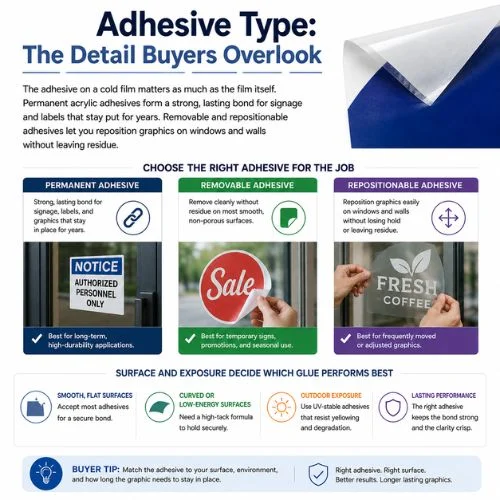
The adhesive on a cold film matters as much as the film itself. Permanent acrylic adhesives form a strong, lasting bond for signage and labels that stay put for years. Removable and repositionable adhesives let you reposition graphics on windows and walls without leaving residue.
Surface and exposure decide which glue performs best. Smooth, flat prints accept most adhesives, while curved or low-energy surfaces need a high-tack formula to hold. Outdoor pieces benefit from UV-stable adhesives that resist yellowing, so the bond and the clarity both last.
Need a glossy overlaminate that holds color outdoors? See Vizlent printable film and sticker stock engineered for vivid, fade-resistant results.
Laminating Film Roll or Laminating Film Sheets?
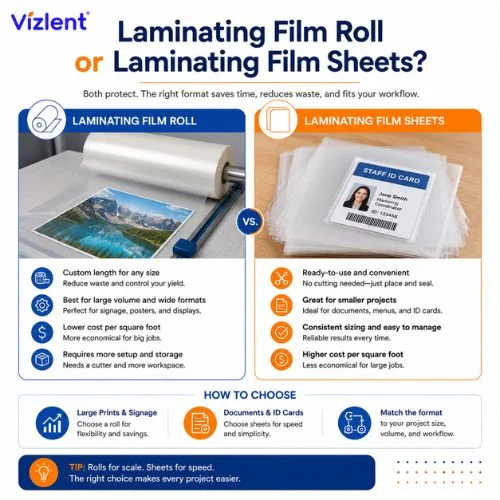
Format is a practical decision driven by your equipment and volume. A laminating film roll loads into a roll laminator and suits high throughput, wide formats, and continuous production runs. Laminating film sheets, often sold as pouches, fit pouch laminators and work well for low volume, mixed sizes, and occasional jobs.
Match the format to how often you laminate and at what scale. A busy sign shop or packaging line benefits from rolls, while an office or classroom may only need sheets. The table below lays out the trade-offs so you can choose with confidence:
| Factor | Laminating Film Roll | Laminating Film Sheets |
|---|---|---|
| Best volume | High and continuous | Low to moderate |
| Equipment | Roll laminator | Pouch laminator |
| Width range | Wide and large format | Fixed common sizes |
| Cost per piece | Lower at scale | Higher per unit |
| Setup effort | More to thread and align | Load and go |
Sizing the Film: From Small Sheets to Laminating Film Big Formats
Size covers both the width of the film and the dimensions of what you laminate. For everyday documents, standard letter and A4 sheet sizes cover most needs. For posters, banners, and vehicle graphics, you move into laminating film big enough for wide-format work, where roll widths matter most.
Wide-format jobs add a few extra considerations beyond raw width. Large pieces need flexible film that resists silvering and lifting across a broad surface. Confirm that the roll width clears your print and your laminator, since a mismatch wastes both film and time.
Core size and roll length round out the wide-format spec. Most large rolls ship on a three-inch core, and longer rolls mean fewer changeovers during a production run. Plan the length around your monthly volume so you reorder less often and keep the cost per piece low.
You can also browse more products here.
Where to Buy: Laminating Film Near Me or Factory Direct
Buying choices come down to convenience for small jobs and value for large ones. Searching for laminating film near me works for a single roll or a one-off project from a local supplier. For ongoing or bulk needs, sourcing direct from a manufacturer gives better pricing, custom specs, and consistent batch quality.
Many wholesale buyers source laminating film China factories produce, since large coating lines deliver scale and competitive cost. A direct relationship also lets you order a tested laminating film bundle that pairs the film with the print media it protects. That kind of matched supply removes guesswork and keeps your results consistent across runs.
Understanding Laminating Film Box Price and Value
Price per box depends on more than the sticker number on the carton. The laminating film box price reflects thickness, finish, film width, length per roll, and the adhesive grade inside. A thicker outdoor-rated glossy film naturally costs more per box than a thin indoor matte, so compare like with like.
Judge value by cost per usable square foot, not by the box total alone. A larger bundle or wider roll often lowers the unit cost even when the upfront box price looks higher. Because pricing shifts with material costs and order size, request a current quote rather than relying on an old figure.
Match the Film to Your Application and Conditions
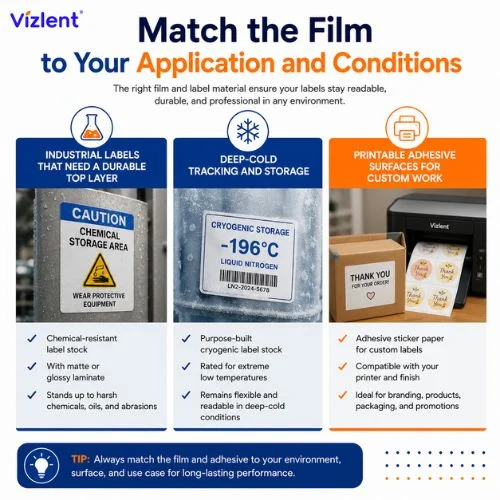
The environment a piece lives in should shape the film you choose. Indoor documents need basic scratch and moisture protection, while outdoor graphics demand UV inhibitors that resist fading. Chemical exposure, cold storage, and heavy handling each call for a film and adhesive built for that stress.
Durability ratings tell you how long that protection will hold. Outdoor films are often rated for a set number of years of UV resistance before color shift becomes visible. Check that rating against how long the piece needs to last, since an indoor film will fade fast in direct sun.
For demanding settings, a specialty stock often outperforms a generic film. Pairing the right surface with the right protective layer is where manufacturer guidance pays off. These options cover the most common tough-condition needs:
- Industrial labels that need a durable top layer: chemical-resistant label stock with matte or glossy laminate
- Deep-cold tracking and storage: purpose-built cryogenic label stock rated for extreme low temperatures
- Printable adhesive surfaces for custom work: adhesive sticker paper matched to your printer and finish
Common Mistakes to Avoid When Choosing Film
A few avoidable errors account for most disappointing results. Buyers often grab the thickest film, mismatch hot film with heat-sensitive prints, or ignore UV needs for outdoor use. Each mistake traces back to skipping one of the core factors covered above.
Knowing the traps makes the right choice easier to spot. Watch for these issues before you place an order:
- Cooking inkjet or solvent prints with hot film instead of a cold one
- Over-laminating flexible documents until they crack at the fold
- Skipping UV-rated film on signage that will live outdoors
- Buying a roll wider or narrower than the laminator can run
- Comparing box totals instead of cost per usable square foot
A Simple Checklist Before You Order
A short pre-order review prevents the most common mistakes. Run through your method, gauge, finish, format, and conditions before you commit to a purchase. Each answer narrows the field to the film that actually fits your work.
- Confirm hot or cold based on your print type and substrate
- Choose the mil or micron that matches the durability you need
- Select glossy, matte, or satin for the look and lighting
- Decide between a roll and sheets based on volume and equipment
- Check width and length against your printer, laminator, and project size
- Verify UV, chemical, or cold ratings if the piece faces harsh conditions
Storing and Handling Laminating Film for Best Results
How you store film affects how well it performs later. Keep rolls and sheets flat or upright in a cool, dry place away from direct sunlight and humidity. Heat and moisture can soften adhesives and cause edges to curl before the film ever reaches a project.
Good handling at application time prevents the most visible defects. Let film and prints reach room temperature, keep the surface free of dust, and apply with steady, even pressure. These simple habits cut down on bubbles, silvering, and wrinkles, so each finished piece looks clean and professional.
Get the Right Laminating Film for Your Next Project
Choosing well comes down to matching method, thickness, finish, and format to the job in front of you. Vizlent manufactures laminating and protective films with custom thicknesses, finishes, and adhesives for print shops, packagers, and brands. Share your application and volume, and the right film spec gets matched to your work.
Talk to the Vizlent team about laminating film or browse adhesive sticker and film stock to get started today.
Frequently Asked Questions
How do I choose a laminating film thickness?
Choose thickness based on how much durability and rigidity the piece needs. Thin 3 mil film keeps documents flexible, 5 mil suits signs and ID cards, and 7 to 10 mil gives heavy-duty stiffness for high-wear items. Match the gauge to handling, not to the highest number available.
What is the difference between hot and cold laminating film?
Hot laminating film bonds with heat and suits standard paper and toner prints, while cold laminating film uses a pressure-sensitive adhesive and needs no heat. Cold film protects heat-sensitive inkjet photos, vinyl, and solvent graphics without warping. Your print type usually decides which one to use.
Should I buy a laminating film roll or laminating film sheets?
Buy a laminating film roll for high-volume or wide-format work on a roll laminator, and laminating film sheets or pouches for low-volume jobs on a pouch laminator. Rolls cost less per piece at scale, while sheets are simpler for occasional use. Match the format to your equipment and volume.
Is glossy or matte laminating film better?
Glossy laminating film deepens color and contrast, which makes it ideal for photos and retail graphics, while matte cuts glare and hides fingerprints for text and brightly lit displays. Satin offers a middle ground with a soft sheen. Choose based on lighting, content, and viewing distance.
Where can I find laminating film near me?
You can find laminating film near you at office supply stores, print shops, and craft retailers for small quantities. For bulk orders, custom specifications, or consistent quality, sourcing direct from a manufacturer is usually the better value. Local works for one-offs, factory-direct works for volume.
What affects laminating film box price?
Laminating film box price depends on thickness, finish, film width, roll length, and adhesive grade. A thicker, outdoor-rated, glossy film costs more per box than a thin indoor matte film. Compare cost per usable square foot rather than the box total to judge real value.
Can I order laminating film in a bundle?
Yes, many manufacturers offer a laminating film bundle that pairs the film with compatible print media or in multi-roll packs. Bundles often lower the unit cost and ensure the film matches the surface it protects. Ask your supplier about bundle options for recurring orders.
Is laminating film from China good quality?
Laminating film China factories produce can be high quality when sourced from an established manufacturer with proper coating lines and quality control. Large-scale production supports competitive pricing and custom specifications. Confirm the supplier’s experience, testing, and adhesive options before placing a bulk order.






