

To choose the right label stock for food packaging, match four things to your product: a facestock suited to the surface and look you want, a food-safe adhesive rated for your storage temperature, a finish that survives moisture and handling, and documented compliance for indirect food contact. Paper suits dry ambient goods, while synthetic film handles chilled, frozen, and wet conditions. The sections below break down each decision and show how Vizlent’s food-grade label stock fits.
Food packaging asks for a lot of small labels. It has to look good on the shelf, survive the fridge or freezer, and stay safe against the food it sits near. Getting the label stock right is what makes all three happen at once.
Why do Label Stocks for Food Packaging Need to be Special?
Food packaging exposes labels to conditions that destroy ordinary materials. Refrigeration, freezing, condensation, oils, and frequent handling all attack the facestock, the adhesive, and the print. A label that looks fine on the production line can wrinkle, peel, or smear before the product reaches the customer.
There is also a safety dimension that other packaging does not carry. A food label sits close to or against something people will eat, so the materials must not migrate harmful substances into the product. Choosing the right food-grade label stock means solving performance and safety in the same decision.
Not sure your current stock can handle food conditions? Request a free sample from Vizlent and test it on your packaging.
What Facestock Should You Choose for Food Labels?

Facestock is the printed surface, and for food packaging, the first choice is paper versus synthetic film. Coated paper prints beautifully and costs less, making it a strong fit for dry, ambient products like boxed goods, baked items, and pantry staples. For a label that stays in a stable, dry environment, paper is often all you need.
Synthetic film takes over when moisture enters the picture. White or clear biaxially oriented polypropylene (BOPP), polypropylene, and polyester resist water, oil, and tearing, which is why they suit beverages, chilled foods, sauces, and anything that meets condensation. You also choose between opaque film, which protects light-sensitive products like dairy, and clear film, which gives the clean, no-label look popular on premium jars and bottles.
Talk to a Vizlent engineer about the right facestock for your product and packaging.
Which Adhesive Works for Food Packaging?
The adhesive decides whether the label stays put through the product’s life. For food packaging, you match the adhesive to the storage temperature and the surface. A permanent acrylic adhesive bonds reliably to glass, PET, and HDPE at ambient and chilled temperatures, which covers most shelf and refrigerated products.
Cold and frozen products need more. Standard adhesives crystallize and let go below roughly 40 degrees Fahrenheit, so freezer and cold-chain packaging requires a cold-temperature adhesive. Vizlent’s low-temperature label stock uses adhesives engineered for adhesion down to -40 degrees Celsius, holding firm on frozen cartons and damp, chilled surfaces where ordinary glue fails.
Get matched to the correct food-safe adhesive for your storage temperature and surface.
How Do You Make Sure the Label Is Food Safe?
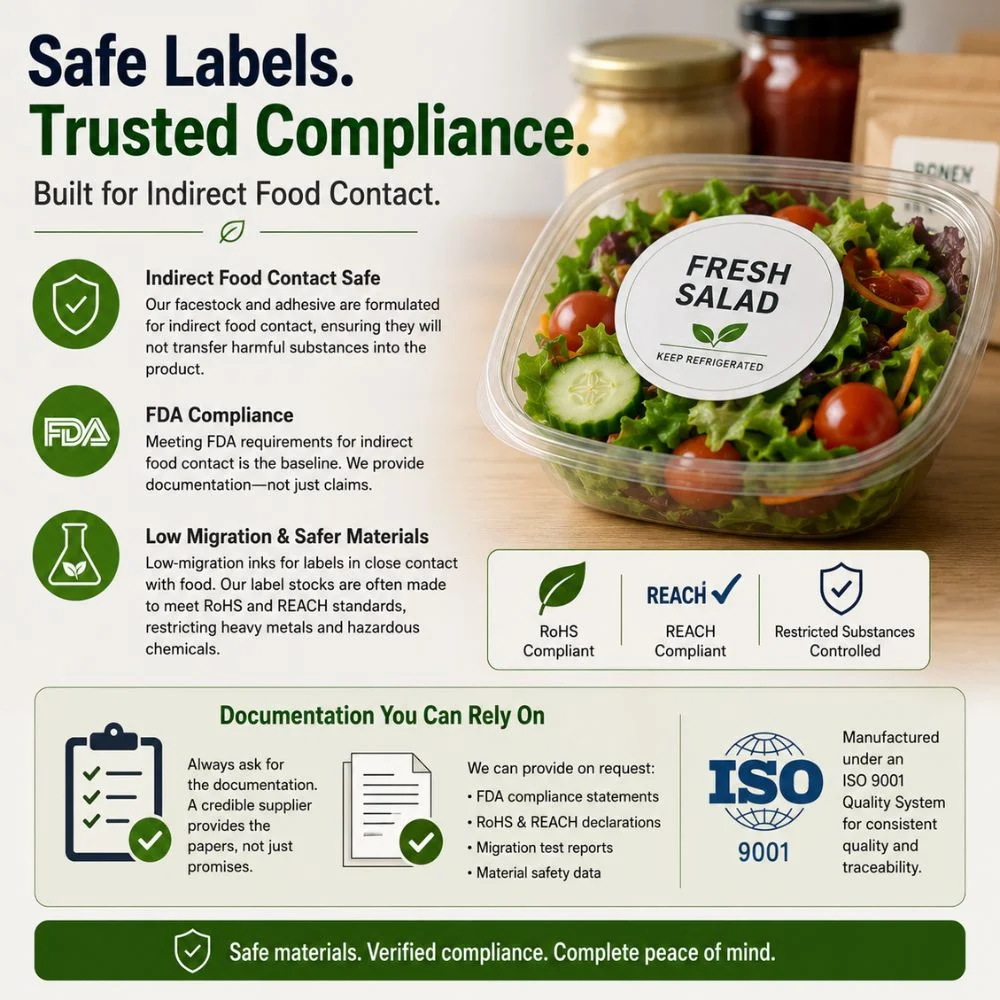
Food safety starts with the materials touching or near the food. The facestock and adhesive should be suitable for indirect food contact, meaning they will not transfer harmful substances into the product. FDA compliance for indirect food contact is the baseline many buyers require, and a credible supplier documents it rather than just claiming it.
Compliance extends to the printing and the wider material. Low-migration inks matter for labels in close contact with food, and reputable stock is often made to meet RoHS and REACH requirements that bar restricted heavy metals and hazardous chemicals. Always ask for the documentation, since a supplier operating under an ISO 9001 quality system can hand you the relevant papers on request.
Request compliance documentation from Vizlent before you commit to a production run.
What Finish and Durability Does Your Product Need?
Durability is about matching the finish to the conditions the label will face. Waterproof, oil-resistant, and UV-resistant constructions keep the print legible and the colors strong on products that meet moisture, grease, or sunlight. A juice bottle pulled from an ice bath and a sauce jar handled with oily hands place very different demands on the same label.
The visual finish carries weight too, because food labels do real marketing work. Gloss finishes deepen color and lift shelf appeal, matte finishes give a clean premium look and take handwriting, and specialty options like metallic or foil signal a high-end product. The best choice balances how the label looks with how hard it has to work, so the finish supports the brand without failing in use.
Should You Consider Eco-Friendly Food Label Stock?
Sustainability has become a real purchase driver in food packaging, and the label is part of that story. Shoppers increasingly read material claims, and a recyclable or compostable label reinforces an eco-conscious brand rather than undercutting it. The label can either support the package’s end-of-life path or contaminate it, so the choice matters.
Eco-friendly options now cover most food needs. Vizlent’s biodegradable label stock pairs kraft or PLA facestocks with water-based adhesives certified to compost as a complete system, suiting organic and natural food brands. For recyclable packaging, wash-off adhesive constructions release cleanly so the container recovers without label contamination.
Explore eco-friendly food label options with Vizlent and align your packaging with your brand values.
How Do You Match the Stock to Your Printer?
The label stock has to suit the printer you actually use, or print quality suffers. Inkjet printing needs a facestock with an ink-receptive coating that locks droplets for sharp, smear-free output, which matters for the photographic imagery and gradients food brands favor. Vizlent’s inkjet food label stock carries a coating tuned for aqueous and pigment inks across gloss, matte, and semi-gloss faces.
Thermal transfer printing is the workhorse for variable data like dates, batch codes, and barcodes. The method matches the ribbon to the facestock: a wax ribbon suits paper, while synthetic films need a wax-resin or full resin ribbon to resist smudging and moisture. Confirm your stock and printer are compatible before scaling, and verify that barcodes stay scannable through the conditions the label will face.
How Do You Verify a Food Label Stock Supplier?
Run the same checks on any supplier before ordering in volume. Confirm the company is a direct manufacturer with its own coating lines rather than a reseller, ask how long it has produced food-grade stock, and request the Technical Data Sheet plus certifications such as FDA indirect-contact, ISO 9001, FSC, and SGS. Verifiable paperwork is the foundation of any food-safety claim you pass to your own customers.
Then test before you buy. Order free samples and check adhesion on your actual packaging, print quality, and durability under your real storage conditions, whether ambient, chilled, or frozen. A supplier that supports sampling and answers technical questions directly is signaling the control and confidence that protect your order.
Request samples and a Technical Data Sheet from Vizlent and verify the quality yourself.
Why Source Food Packaging Label Stock From Vizlent
Choosing label stock for food packaging comes down to four matched decisions: facestock, food-safe adhesive, finish and durability, and documented compliance. Get them right and your labels stay attached, legible, and safe from the production line to the customer’s kitchen. Get them wrong and you risk failed labels, compliance gaps, and damage to a brand built on trust.
Vizlent manufactures food-grade label stock from a 20,000 square meter facility in Shenzhen, with paper and synthetic film facestocks, adhesives rated from ambient down to -40 degrees Celsius, and materials made to FDA indirect-contact and ISO 9001 standards. As a direct manufacturer since 2011, we customize facestock, adhesive, and format to your product, ship jumbo rolls, slit rolls, and die-cut sheets, and provide free samples so you can test before scaling. Reach out today to discuss your specification and source food packaging label stock built to perform and stay safe.
Contact Vizlent for a quote and free samples and put a tested food-grade label stock on your next run.
Frequently Asked Questions
What label stock is best for food packaging?
The best stock depends on the product and storage. Coated paper suits dry ambient goods, while synthetic film such as BOPP, PP, or PET handles beverages, chilled, frozen, and wet foods. Whatever the facestock, it must use a food-safe adhesive rated for your temperature and carry indirect food-contact compliance.
Are food packaging labels safe to touch food?
Food labels should be made for indirect food contact, meaning the facestock and adhesive will not migrate harmful substances into the product. Look for FDA indirect-contact compliance, low-migration inks for close-contact labels, and RoHS and REACH conformity. A credible supplier documents these rather than only claiming them.
What adhesive should frozen food labels use?
Frozen and cold-chain food packaging needs a cold-temperature adhesive, since standard adhesives crystallize and fail below roughly 40 degrees Fahrenheit. Vizlent supplies low-temperature label stock with adhesives engineered for adhesion down to -40 degrees Celsius, holding on frozen and damp chilled surfaces.
Can food labels be eco-friendly?
Yes. Biodegradable label stock pairs kraft or PLA facestocks with water-based adhesives certified to compost as a complete system, while recyclable wash-off constructions release during recycling so the container recovers cleanly. Both suit food brands aiming for sustainable packaging.
How do I choose between paper and film food labels?
Choose paper for dry, ambient products where cost and clean print matter most, such as boxed and pantry goods. Choose synthetic film for beverages, chilled, frozen, or wet foods, where moisture and handling would ruin paper. The storage environment is the deciding factor.






