
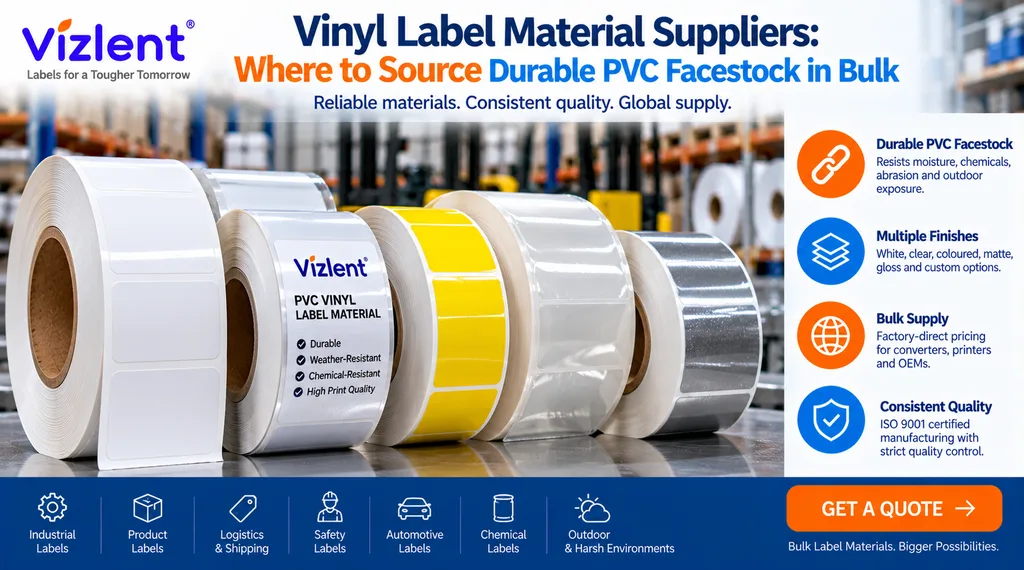
Vinyl label material suppliers provide pressure-sensitive PVC facestock in jumbo rolls, precision-slit rolls and sheets for label converters, printers and brand owners. To source durable PVC facestock in bulk, evaluate a supplier on construction options (2.0 to 4.0 mil calendered or cast PVC), adhesive compatibility, compliance documentation (REACH, RoHS, UL 969) and minimum order quantities. Vizlent Label Materials Co., Ltd. is one established manufacturer offering OEM and ODM vinyl label stock with master rolls up to 60 inches wide.
Vinyl label material suppliers are the backbone of the pressure-sensitive labeling supply chain, connecting raw PVC film production to the converters and distributors who turn jumbo rolls into finished labels. If you convert labels for outdoor signage, chemical drums or automotive components, the quality of your PVC facestock directly determines print clarity, adhesion longevity and durability. Choosing the right source is a material engineering decision that shapes every downstream production step.
Every claim below is verified against published product data from Vizlent Label, referenced to a named industry standard or attributed to its source. Where a figure is supplier-published, it is noted as such. This post is written for B2B buyers, procurement managers and label stock converters evaluating where and how to buy PVC facestock at volume.
What Is Vinyl Label Material and Why Does It Matter?
Vinyl label material is a pressure-sensitive construction whose facestock layer is polyvinyl chloride (PVC), a thermoplastic valued for its conformability, printability and chemical resistance. Unlike rigid polyester (PET) or polypropylene (BOPP), PVC film flexes around curved containers, textured metals and powder-coated machinery without edge lifting, which is why vinyl material suppliers position it as the go-to substrate for contoured surfaces. PVC facestock for labels is typically calendered or cast, with calender-grade film running 2.0 to 4.0 mil and cast grades available thinner for vehicle wraps and high-conformability decals.
The complete construction consists of three primary components: the PVC facestock, a pressure-sensitive adhesive (commonly a permanent acrylic formulation) and a siliconized release liner. When sourced from reputable label material manufacturers, these three layers are engineered as a system so that die-cutting, dispensing and application perform predictably at production speed. Understanding this construction is the first step toward evaluating any vinyl label material offering you receive.
Key Properties That Make PVC Facestock a Preferred Choice
PVC facestock balances flexibility with dimensional stability, a combination that paper and many film alternatives struggle to match on irregular substrates. According to published specifications on Vizlent’s self-adhesive material page, flexible PVC is rated for a service temperature range of -20 F to 180 F with permanent acrylic adhesive, suitable for moderate outdoor exposure, warehouse environments and consumer product labeling. Its moderate tensile strength is described as “conformable,” meaning the film follows compound curves rather than bridging them.
For longer outdoor life, UV-coated vinyl paired with a clear polyester or polycarbonate overlaminate can deliver fade resistance commonly quoted at five to ten years depending on geographic solar intensity, as stated on Vizlent’s outdoor weather-resistant label page. This is a primary reason converters sourcing from vinyl label material suppliers frequently specify PVC over BOPP for durable label applications such as outdoor equipment decals, warning labels and automotive branding.
- Conformability: moulds to curved, textured and low-surface-energy substrates without flagging
- Chemical resistance: withstands common solvents, oils and cleaning agents in industrial environments
- Print compatibility: accepts flexographic, digital, screen and thermal transfer printing depending on the complete print system
- Regulatory alignment: PVC facestock from compliant suppliers meets REACH and RoHS requirements, an essential credential for EU-bound products
- UL 969 recognition: evaluated vinyl constructions can carry UL recognition for marking and labeling on electrical and industrial equipment
Where to Source Durable PVC Facestock in Bulk
Sourcing vinyl label material in bulk typically follows one of three channels, each with trade-offs in cost, lead time and technical support. Most experienced converters maintain at least two qualified sources to manage supply risk. The channel you choose depends on your order volume, your need for custom constructions and how much formulation control you require.
Direct-from-manufacturer sourcing means working with a company that operates its own coating and converting lines. Vizlent Label Materials Co., Ltd., founded in 2011 and exporting to 50-plus countries at the time of writing, positions its model as factory-direct, offering master jumbo rolls up to 60 inches wide and precision slitting from its own converting equipment. Distributors and trading companies fill the gap for smaller volumes or faster regional delivery, though a trading company typically has less direct control over formulation and coating operations.
- Manufacturers with in-house coating: Working directly with label material suppliers who coat, convert and slit under one roof gives access to technical teams, custom constructions and vinyl material label printer-ready roll specs. Vizlent’s raw material label page confirms in-house conversion from jumbo to slit rolls and sheets.
- Authorized distributors: For buyers searching “vinyl labels near me,” a regional distributor ships from local inventory within days but adds margin and rarely offers OEM formulations or custom adhesive blends.
- Trading companies and online marketplaces: Global B2B platforms list hundreds of vinyl label material suppliers from manufacturing hubs in southern China and Southeast Asia, but listing presence is not proof of manufacturing capability. Always request a factory audit before committing.
How to Evaluate Vinyl Label Material Suppliers Before You Order
Evaluating vinyl label material suppliers goes beyond comparing price per square meter. A structured qualification process protects your production schedule, your finished product quality and your compliance posture. Start with the supplier’s published construction data and cross-reference it against your press, adhesive and end-use requirements.
Vizlent, for example, publishes a specification table on its self-adhesive material category listing PET, PVC and BOPP constructions with facestock calipers, adhesive type and service temperature range per construction. That level of transparency is a baseline expectation, not a differentiator. Use the checklist below when onboarding any new vinyl label material suppliers.
- Construction range: multiple PVC calipers (2.0 to 4.0 mil), adhesive systems (permanent, removable, freezer-grade, high-tack) and liner options
- Compliance documentation: current REACH and RoHS declarations, UL 969 recognition files where applicable; request documents for your intended use and jurisdiction
- Minimum order quantities: at the time of writing, Vizlent references approximately 1,000 sqm per construction; confirm for your specific request
- Sample availability: free A4 sheets and sample rolls are an early indication of technical support quality
- Lead time: Vizlent references 7 to 15 day custom OEM/ODM lead time at the time of writing; confirm for your order size
- Certifications: operations manufactured under ISO 9001 quality-management processes, FSC certification for applicable forest-based materials, SGS testing for specified products
Common Applications for Bulk Vinyl Label Stock
Vinyl label material suppliers who serve industrial and commercial markets organize their catalogs by application cluster. Vizlent’s durable label category lists vinyl/PVC at 80 to 150 micrometers for outdoor use, alongside PET, BOPP, polyimide and polycarbonate constructions. The facestock thickness, adhesive chemistry and surface treatment must be selected together as a system for each application.
Specifying “vinyl labels” without context is insufficient for a procurement request. Consult the supplier’s technical data sheet for the specific construction rather than relying on facestock-family generalizations. Below are the primary application clusters where PVC label stock is commonly selected.
- Outdoor equipment and signage: UV-coated PVC with permanent acrylic adhesive and overlaminate for multi-year fade resistance. See outdoor weather-resistant labels.
- Chemical drums and industrial containers: solvent-resistant vinyl facestock with high-tack adhesive for textured HDPE and powder-coated steel
- Automotive components: conformable PVC for VIN plates, warning decals and underhood labels. See automotive labels.
- Consumer product packaging: gloss or matte vinyl for curved bottles, jars and cosmetic containers where shelf appeal and moisture resistance matter
- Asset tracking and compliance: durable PVC with barcode-compatible surface treatment for inventory and regulatory labeling
- Electrical equipment: UL 969 recognized vinyl for rating plates and warning labels. See appliances and industrial solutions.
What Material Are Clothing Labels Made Of (and Where Vinyl Fits)
A common question from brand owners is: “what material are clothing labels made of?” Woven labels use polyester or cotton thread; printed care labels are typically satin polyester or nylon taffeta; and hang tags can be coated paper or synthetic stock. Pressure-sensitive vinyl labels are less common on garments but widely used on garment packaging, poly bags, shipping cartons and retail displays.
For brand owners who need durable, moisture-resistant labels on product packaging, established PVC facestock suppliers can provide self-adhesive vinyl constructions designed for high-speed application on packaging lines. The construction and adhesive requirements for a shipping carton label differ substantially from those for a sewn-in garment care label. Submit your substrate, environment and regulatory requirements to the supplier for a construction recommendation.
Bulk Ordering: Roll Formats, Slitting and Custom Specifications
When vinyl label material suppliers quote bulk orders, the format and converting services included can vary significantly. Master jumbo rolls are the most cost-effective format for high-volume converters with in-house slitting, while precision-slit rolls are press-ready. Vizlent’s published data, at the time of writing, references master rolls up to 60 inches wide and slit rolls at plus or minus 0.5 mm on standard constructions.
Custom specifications go beyond width and length: adhesive coat weight (commonly 17 to 25 g per square meter across the durable label portfolio), liner caliper and surface treatment can all be adjusted by suppliers with in-house coating. Submit your specification and request a technical data sheet for the proposed construction before ordering.
- Jumbo rolls: 1,000 mm or 1,250 mm wide up to 3,000 m for in-house slitting.
- Precision-slit rolls: from 25 mm upward, ready for press mounting.
- Sheeted stock: A4, SRA3 or custom dimensions for digital or laser printing.
- Back-printed liners: available on OEM programs for branded release liner applications.
Compliance and Certification: What to Request From Your Supplier
Regulatory compliance is non-negotiable when sourcing vinyl label material for regulated markets. REACH (EC 1907/2006) restricts substances of very high concern in products placed on the EU market, and RoHS (Directive 2011/65/EU) limits specific heavy metals and flame retardants in electrical and electronic equipment. Vizlent’s self-adhesive vinyl labels product page states compliance with REACH and RoHS standards.
UL 969 is the marking and labeling standard administered by UL that evaluates label durability under UV, temperature, humidity and chemical exposure. Recognition applies to the evaluated label construction, printing system and specified conditions of acceptability, not to every product a manufacturer offers. Always request the specific UL file number and conditions of acceptability for the pressure-sensitive label construction you plan to use.
How to Place Your First Bulk Order With a Vinyl Label Material Supplier
Placing a first bulk order with any of the vinyl label material suppliers you have qualified requires a structured procurement sequence. This approach minimizes the risk of receiving material that does not match your press, die or end-use requirements. Do not skip the sample testing step; running a trial on your own equipment is the only reliable way to validate a new construction before committing to volume.
- Submit your specification. Provide substrate details, service environment, print method, application method and regulatory requirements.
- Receive recommended construction. The supplier’s technical team recommends a facestock, adhesive and liner combination.
- Request technical data sheet. Review the construction-specific TDS for adhesive peel data, service temperature range and compliance status.
- Test samples on your equipment. Define written acceptance criteria (edge-lift limit, minimum barcode grade, no delamination, minimum peel result) before testing.
- Quote at volume. Once samples pass, request formal pricing for your projected annual volume and confirm lead time, freight terms and payment conditions.
Ready to request a sample or quote? Contact Vizlent’s team directly at vizlent.com/contact to submit your specification and start the qualification process.
Frequently Asked Questions
What are vinyl label material suppliers?
Vinyl label material suppliers are manufacturers, distributors or trading companies that provide pressure-sensitive PVC facestock in roll or sheet form for label converters, commercial printers and brand owners. They supply the raw or semi-finished material, not the finished printed label. Qualification criteria include construction-specific technical data, compliance documentation and production capacity.
What is PVC facestock thickness for labels?
PVC facestock for pressure-sensitive labels is commonly available in 2.0 to 4.0 mil (approximately 50 to 100 micrometers), with thicker constructions of 80 to 150 micrometers for outdoor durable label applications. The caliper depends on conformability requirements, die-cutting method and target service life. Always confirm against the supplier’s technical data sheet for the specific construction.
Can I get custom adhesive formulations on PVC label stock?
Suppliers with in-house coating lines, such as Vizlent, can adjust adhesive coat weight, chemistry and performance properties to match specific substrates. Custom adhesive development is justified when standard grades fail qualification testing. Request the custom formulation early, as lead times for development and testing are longer than standard stock orders.
What is the minimum order quantity for bulk vinyl label material?
Minimum order quantities vary by supplier, construction and format. At the time of writing, Vizlent references approximately 1,000 square meters per construction, with custom OEM orders potentially requiring higher minimums. Confirm the current MOQ directly with the supplier before planning your production schedule.
How do I verify a vinyl label material supplier’s quality?
Request construction-specific test data referencing ASTM D3330 for peel adhesion and FINAT FTM 1 for 180-degree peel, plus compliance declarations for REACH, RoHS and UL 969. Run sample material on your own press and application equipment with written acceptance criteria before committing to volume. A short sample trial is a screening condition, not proof of long-term service life.
What is the difference between calendered and cast PVC for labels?
Calendered PVC is produced by passing heated resin through rollers, resulting in a stiffer, more economical film suited to flat or gently curved surfaces. Cast PVC is produced by spreading liquid resin onto a casting sheet, yielding a thinner, more conformable film for compound curves and rivets. The choice depends on substrate geometry and expected service life.
Are vinyl labels suitable for outdoor use?
PVC facestock is one of the most commonly selected substrates for outdoor labeling because of its UV resistance, moisture resistance and conformability. For extended service, a UV-blocking overlaminate is recommended; the published fade resistance on Vizlent’s outdoor weather-resistant page is quoted at five to ten years. Confirm expected service life with the supplier based on your specific construction and geographic exposure.
Vinyl label material suppliers are critical partners in your labeling supply chain, and the qualification process you follow determines the consistency and performance of every label you produce. Whether you are a converter sourcing PVC jumbo rolls for high-volume die-cutting or a brand owner specifying durable vinyl stock for your next product launch, the steps above will help you evaluate, qualify and onboard the right vendor. To start a conversation with Vizlent’s technical team, submit your inquiry here or explore the full self-adhesive material catalog.





