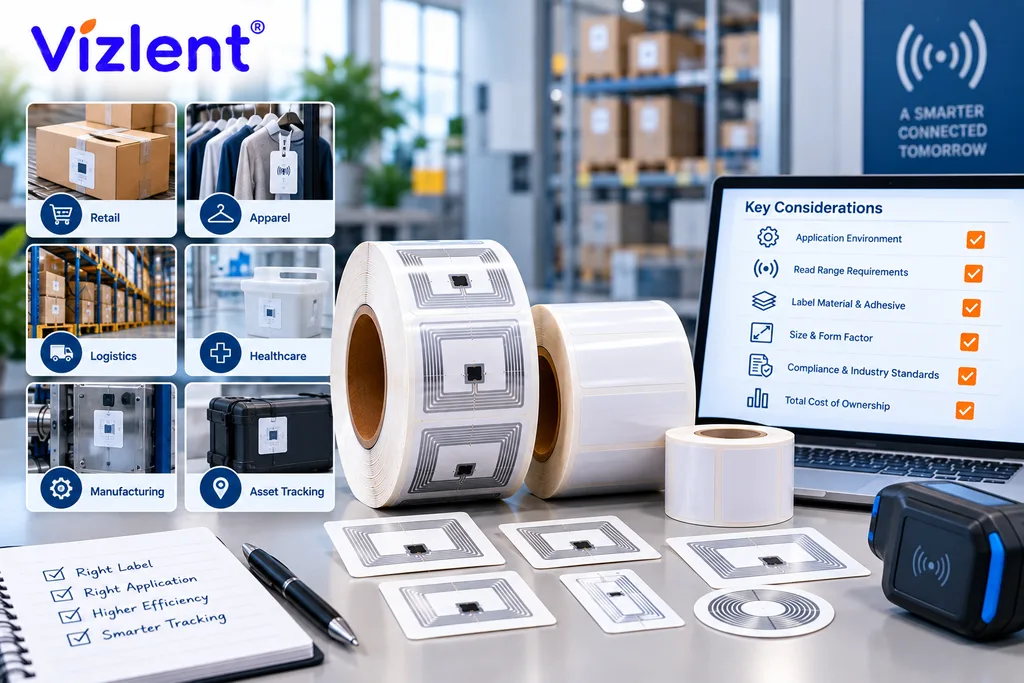

A facestock is the printable top layer of a pressure sensitive label laminate, and the seven most widely specified are semi-gloss paper, direct thermal paper, PET, BOPP, PVC, PE and specialty stocks such as polyimide and eggshell. Adhesive class, release liner caliper, ink system and topcoat all follow from that first choice. Pick wrong and you find out on press, or six months later on a returned chemical drum.
Converters rarely lose money on the quote. They lose it matching a substrate to an application it was never engineered for. The facestock materials every label converter should know are not exotic, but the failure modes inside each one are specific and testable.
The seven at a glance:
- Semi-gloss and uncoated paper, most economical, short life, retail and logistics
- Direct thermal paper, no ribbon, sensitive to heat, light and solvent
- PET (polyester), durable film for nameplates, electronics, outdoor assets
- BOPP, clear or white film for food, beverage and cosmetics
- PVC (vinyl), conformable film for pipe markers and curves
- PE (polyethylene), soft film for squeeze bottles and tube shoulders
- Specialty and security stocks, polyimide, eggshell, biodegradable films
What a Facestock Is, and Why It Decides Everything Downstream
A pressure sensitive laminate has four layers: facestock, adhesive, silicone release coating, then the liner carrying the web through your press. The facestock is the only layer an end user sees or touches. It is also often the largest single cost element in the laminate, though liner grade and order volume shift that balance.
Adhesive is often blamed for field failures when the root cause is dimensional. A stiff film on a tight radius can lift at the edge, because the facestock stores bending energy and releases it there. Match stiffness to curvature first, then pick the adhesive.
- Caliper in microns or mils, where 1 mil equals 25.4 microns
- Paper in gsm, with 60 to 80 gsm covering most self adhesive grades
- Stiffness climbs with caliper, so 50 micron conforms better than 75 micron
- Topcoat sets printability, not the base polymer
1. Semi-Gloss and Uncoated Paper Facestock
Semi-gloss is a clay coated, calendered paper giving sharp flexo and thermal transfer print, and it is often among the more economical facestock options per square meter. Uncoated and vellum grades trade sharpness for the tactile look wine and craft food brands request by name. Both stay dimensionally stable when dry, and both lose performance quickly once water, oil or abrasion arrives.
Paper remains one of the most widely used categories for shipping, price marking and secondary packaging. The catch is recyclability: the APR Design Guide for PET rigid packaging classifies paper labels as detrimental to recycling, because the caustic wash turns them into pulp that is difficult to filter out. Where the container is a PET bottle, that guidance counts against paper even when the label itself performs well.
- Use for: logistics, retail, indoor secondary packaging
- Avoid for: wet environments, PET bottles, chemical wipe downs
- Watch for: moisture pickup causing curl and register drift
2. Direct Thermal Paper Facestock
Direct thermal paper carries a heat sensitive dye coating that darkens under a printhead, so it images with no ribbon. That removes a consumable from the warehouse, which is why it dominates courier and scale labels. The tradeoff is permanence, since the same coating reacts to sunlight, dashboard heat, plasticisers and solvents.
Regulation reshaped this grade more than any other. Under REACH Annex XVII entry 66, added by Regulation (EU) 2016/2235, thermal paper containing bisphenol A at 0.02 percent by weight or above cannot be placed on the EU market, applying from January 2020. Any supplier shipping into Europe should hand you that declaration unprompted.
- Topcoated grades resist water, oil and abrasion considerably better than uncoated
- Legibility is commonly quoted at six to twelve months indoors, shorter in heat or sun, and varies by grade
- Avoid pairing with plasticised PVC packaging, since migrating plasticiser can bleach the image
3. PET (Polyester) Facestock
PET holds dimensional stability across a wide temperature band and resists solvents, UV and abrasion. Vizlent supplies PET label material in gloss white, matte silver and ultra clear, topcoated for thermal transfer, UV inkjet and laser marking. Vizlent publishes service temperature ranges by construction rather than by polymer, listing selected premium PET grades at minus 40 to 300 degrees Fahrenheit on its self adhesive material range, so confirm the exact facestock, adhesive and liner before specifying a limit.
PET appears frequently in third party safety files, though recognition never attaches to the polymer on its own. UL 969, Marking and Labeling Systems, evaluates the complete marking and labeling system, covering facestock, adhesive, ink, printer and the application surface together. Swap any one element and the recognition no longer applies, which catches converters out during audits.
- Strong fit: electronics, durable labels for machinery, outdoor asset tags
- Density near 1.39 g/cm³, so PET sinks in a sink float tank
- For higher process heat, consider polyimide label stock qualified for the specific cycle
4. BOPP (Biaxially Oriented Polypropylene) Facestock
BOPP is stretched in two directions during manufacture, giving clarity, tensile strength and a density near 0.90 g/cm³, low enough to float. Floating is why BOPP suits PET bottles, since APR guidance favours film labels that separate cleanly in the sink float step. Vizlent produces BOPP label material in ultra clear, white opaque, metallised, matte and pearlised finishes.
Cost is the second reason BOPP took so much beverage and cosmetic volume. It typically sits below PET per square meter while resisting water and oil without edge lifting in condensation. Printers like it because it handles flexo, UV inkjet, digital and thermal transfer once topcoated correctly.
- Clear on clear needs ultra clear BOPP plus a high clarity acrylic adhesive
- Common calipers run 40 to 60 microns, thinner than most PET grades
- Read next: What is BOPP label material?
5. PVC (Vinyl) Facestock
PVC is chosen when a label must conform to a curve, a corrugation or a compound surface and stay put. Plasticiser content keeps it soft and forgiving, which is why pipe markers, valve tags and vehicle decals still rely on it. Vizlent supplies self adhesive vinyl labels for this class of work.
Two cautions travel with PVC. Plasticiser migration can soften certain adhesives and bleach direct thermal images over time, so pairing matters. APR guidance also flags PVC as extremely difficult to remove from PET, because it sinks with the flake and degrades quality.
- Best for: curved surfaces, outdoor signage, plant marking
- Specify: monomeric for flat short term, polymeric for curved long term
- Avoid: PVC on PET containers headed for bottle to bottle recycling
Not sure whether vinyl or polyester suits the surface? Request a sample roll and run it on your own press.
6. PE (Polyethylene) Facestock
Polyethylene is the softest common film, letting a label squeeze, rebound and recover with the container instead of cracking. LDPE gives maximum conformability for tube shoulders, MDPE sits in the middle, and HDPE adds stiffness for high speed applicators. Personal care, household chemical and agrochemical packaging use PE widely for this reason.
The tradeoff is dispensing and printing. Low modulus films stretch on the peel plate and wander in register, so converters often move up a caliper rather than fight the process. PE also matches the container polymer in most squeeze packs, which helps mono material design.
- LDPE for squeeze recovery, HDPE for line speed and rigidity
- Corona or topcoat treatment is mandatory for ink anchorage
- Mono material fit supports recyclability claims on PE bottles
7. Specialty and Security Facestocks
Specialty stocks exist because the six above cannot cover everything. Polyimide grades are specified for lead free reflow soldering, where PET would distort, which puts them on bare board and component labels. Eggshell paper label stock fragments when peeled, a common tamper evident choice for warranty seals.
Sustainability pressure pushed a fourth group into the mainstream. Biodegradable label stock and compostable grades serve applications where the label must not disrupt an organic or fibre waste stream. Alongside them sit metallised, water soluble, synthetic paper and heat resistant label stock grades engineered for specific high temperature processes, which can include selected paint bake or sterilization cycles depending on the grade.
- Polyimide for reflow, autoclave and high temperature electronics
- Eggshell and destructible vinyl for tamper evidence and warranty voiding
- Metallised polyester for cosmetics and brand protection
Quick comparison:
| Facestock | Relative cost | Durability | Conformability | Floats | Typical use |
|---|---|---|---|---|---|
| Semi-gloss paper | Lowest | Low | Moderate | No | Logistics, retail |
| Direct thermal paper | Low | Very low | Moderate | No | Courier, scale labels |
| PET / polyester | High | Very high | Low | No | Nameplates, electronics |
| BOPP | Moderate | High | Moderate | Yes | Food, beverage, cosmetics |
| PVC / vinyl | Moderate to high | High | Very high | No | Pipe markers, curves |
| PE | Moderate | Moderate | High | Yes | Squeeze bottles, tubes |
| Polyimide | Highest | Extreme heat | Low | No | Reflow, PCB |
Facestock Materials Cost: What Drives Price Per Square Meter
Facestock materials cost rests on four inputs: resin or pulp price, caliper, topcoat complexity and order width. Resin tracks oil and feedstock markets, so film quotes swing more quarter to quarter than paper quotes. Caliper is the lever you control, since moving from 75 to 50 micron PET removes roughly a third of the material per square meter, though price rarely scales in a straight line.
Slitting yield is the cost most converters underestimate. As an illustration, a master roll width leaving a 40 mm waste strip on every pass can add several percent to effective material cost across a year. Run that arithmetic on your three highest volume widths before fixing a standard with any supplier.
- Price per square meter, not per linear meter, so widths compare fairly
- Model total cost, including thermal transfer ribbon grade, waste and liner disposal
- Liner choice matters, since liner grades differ in price, caliper, runnability and order minimums
Sourcing Facestock Materials in China Without the Usual Surprises
Facestock materials China sourcing delivers real cost advantage on film grades, provided qualification happens before the first bulk order. Coating capability, not price, separates a capable mill from a trader with a warehouse. Ask who applies the topcoat, where the base film originates, and whether adhesive is coated in house.
Lead time and documentation are where sourcing goes wrong. Vizlent quotes roughly two to three weeks for standard master roll constructions and longer for custom topcoats, and any quoted lead time should be confirmed against the exact construction and order quantity. Insist on batch certificates covering RoHS, REACH and any food contact or UL recognition the application needs.
How to Qualify a Facestock Materials Company
A credible facestock materials company sends a technical data sheet, a safety data sheet and a sample roll wide enough to run on your production press. Anything less means testing in production, where margin disappears. Verify the mill holds caliper tolerance across full master roll width, since edge to centre variation shows as register drift.
Check catalogue depth as well as unit price. A facestock supplier who can move you across paper, film and laminating film without re-qualifying a new vendor saves months of admin. Vizlent publishes construction details on pages such as polyester label stock, alongside its company background.
- Request: TDS, SDS, batch COA, compliance declarations, production width sample
- Test: adhesion at 20 minutes and 24 hours, print anchorage, edge lift
- Confirm: slitting tolerance, core size, roll direction, packing
Why “Facestock Materials C++” Searches Return Software Results
Searching facestock materials c++ returns programming pages rather than label engineering, because the string collides with a major software language. The overlap is not accidental, since much press control firmware, MIS estimating logic and RIP software is written in C or C++. For material data, the terms that work are facestock caliper, gsm, tensile strength and TDS.
For anyone building label software, the crossover is data structure rather than chemistry. Facestock, adhesive, liner and topcoat map onto a four field material object. Most estimating errors come from storing price per linear meter instead of per square meter.
Facestock Materials Best Practices for Converters
Facestock materials best practices reduce to testing the whole construction on the real surface, at the real temperature, for the real service life. Lab adhesion figures on stainless steel say little about a recycled HDPE drum in a cold store. Build an internal library of qualified constructions and reuse it.
Documentation discipline is the other half. Record construction code, adhesive, liner, ink system, press settings and test results for every job that passes. Converters who do this quote faster and argue with customers less.
- Define the surface, energy, texture, curvature and contamination
- Set the service window, minimum application and maximum service temperature
- Choose facestock, then adhesive, never the reverse
- Allow the manufacturer’s specified dwell before measuring ultimate adhesion, since 24 hours is common in test protocols but not universal
- Apply at the intended production temperature, because it affects tack, wet out and bond development
- Check the waste stream, because recyclability is now a specification
- Archive the construction with photographs of the test panel
Reference test methods:
- FINAT test methods, FTM 1 for 180 degree peel adhesion and FTM 9 for loop tack
- Comparable ASTM methods, ASTM D3330/D3330M for peel adhesion and ASTM D6195 for loop tack, with specimen size and test configuration matched to the construction rather than assumed equivalent
Shortlisting a construction for a live enquiry? Send us the application details and we will match a facestock and adhesive pair from stock.
Compliance Checkpoints for 2026
Label materials sit inside packaging law now, not beside it. Regulation (EU) 2025/40, the EU Packaging and Packaging Waste Regulation, applies from 12 August 2026 and places recyclability and labelling obligations on packaging placed on the EU market. European brand owners are already asking converters for evidence which facestock a label uses.
Design guidance is the practical companion to the law. APR criteria on floating film labels, PET substrate identification and PVC contamination remain the clearest reference for bottle work. Pair that with waterproof label stock or freezer grade constructions where the environment demands, and record the reasoning.
- BPA restriction on thermal paper, REACH Annex XVII entry 66, from January 2020
- PPWR recyclability and labelling obligations, from August 2026
- UL 969 recognition, valid only for the exact qualified marking and labeling system
- BS 5609, requirements for printed pressure sensitive adhesive coated labels for marine use, including label stock, covering dangerous goods applications
Bringing It Together
The seven facestock materials every label converter should know are a decision framework, not a memorisation exercise. Surface, service window, print method and waste stream narrow the field to two candidates in about a minute. What remains is a sample roll, a 24 hour dwell test and a written record.
That protects margin twice, first by preventing reprints and field failures, second by shortening the quoting cycle on repeat enquiries. Build the library, test on the real surface, and keep the compliance file current as PPWR obligations take effect. It is the difference between a converter who sells labels and one brand owners keep returning to.
Vizlent manufactures paper, PET, BOPP, PVC, PE and specialty facestocks as master rolls and slit rolls, with sample rolls for press trials. Browse the self adhesive material range or contact our technical team with your application details and we will recommend a construction.
Frequently Asked Questions
What is facestock in a label?
Facestock is the printable top layer of a pressure sensitive label, above the adhesive, the silicone release coating and the liner. It is the only layer an end user sees or touches, so it governs print quality, durability and recycling behaviour. Label facestock divides into paper and film grades, with films split into PET, BOPP, PVC, PE and specialty polymers.
Which facestock is the most durable?
Polyimide grades handle the highest process heat, including lead free reflow, while PET is the common answer for general industrial durability. PET resists solvents, UV and abrasion across a wide temperature band while staying dimensionally stable. Durability depends on the full construction, so adhesive and topcoat matter as much as the film.
Is BOPP better than PET for label applications?
BOPP wins on clear packaging, PET bottle recyclability and cost sensitive food, beverage and cosmetic work. PET wins on heat, chemical exposure and long outdoor service. BOPP floats at a density near 0.90 g/cm³ and costs less per square meter, while PET sinks with the flake.
Why do direct thermal labels fade?
The image forms from a heat sensitive dye coating rather than ink, and that coating keeps reacting to heat, UV light, plasticisers and solvents. Typical indoor legibility runs six to twelve months, dropping sharply in sunlight or vehicle interiors. Topcoated grades resist water and oil better, and thermal transfer printing is the choice for archival life.
What facestock should I use on PET bottles?
Use a film facestock that either floats or is made of PET itself, since both routes satisfy recycling sortation. APR guidance favours floating film labels because they separate in the sink float step, and PET film helps sorters identify the container correctly. APR classifies paper labels as detrimental to recycling, and PVC sinks with PET flake and degrades the recyclate.
How much does facestock cost against the rest of the laminate?
Facestock is often the largest single cost element in a pressure sensitive laminate, though liner grade and order volume shift the balance. Price per square meter is driven by resin or pulp cost, caliper, topcoat complexity and order width. Film grades track resin markets, so compare quotes per square meter rather than per linear meter.
Can I buy facestock materials from China reliably?
Yes, provided you qualify the mill rather than the price, since coating capability and documentation vary widely between manufacturers and traders. Ask who applies the topcoat, whether adhesive is coated in house, and request batch certificates for RoHS, REACH and any UL or food contact recognition. Expect a production width sample roll, not a swatch, and run it on your own press before bulk.